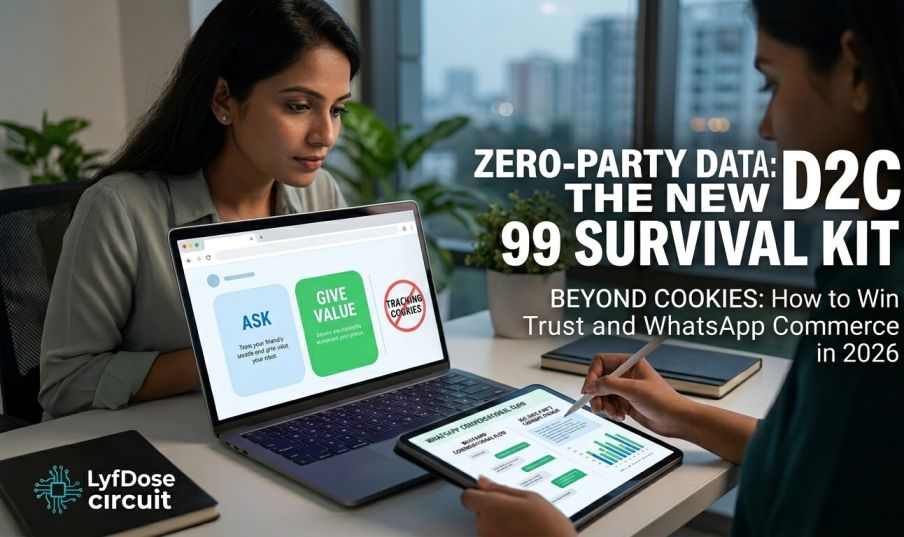
The era of digital surveillance is over. As third-party cookies crumble into the archives of internet history, we are witnessing a massive shift in how brands interact with their customers. We no longer track; we ask. For any scaling business in the subcontinent, finding the right Zero-party data tools for Indian D2C brands isn't just a technical upgrade—it is a survival mandate. We are moving from a world of "creepy" tracking to one of "conscious" sharing. Here, the customer is in the driver’s seat. Finally.
Key Takeaways
- Trust as Currency: Zero-party data is information customers intentionally share. It’s the highest quality data available.
- The WhatsApp Advantage: In India, the browser is dead. Conversational commerce via WhatsApp is the primary engine for data collection.
- Value is Mandatory: Users won't give up their preferences for free. You need a robust exchange framework.
Understanding the Hierarchy: Zero-Party Data vs First-Party Data
To dominate the Indian D2C space, we have to stop confusing our data sources. While both are "owned," they serve vastly different masters. One is a digital footprint; the other is a direct conversation.
The Real-World Scenario: The Fashion Startup’s Flop
Imagine a Mumbai-based apparel brand. They have tons of first-party data: purchase history, clicks, and time spent on site. They see a user bought a red dress. They spend ₹50,000 retargeting her with red dresses. The result? Total silence. Why? Because the red dress was a gift for a cousin. If they had used zero-party data—simply asking, "Who are you shopping for today?"—they would have known to show her office wear for herself instead.
Hot Take: First-party data tells you what happened. Zero-party data tells you why. Stop playing detective. Start being a host.
Under-the-Hood: Behavioral Traces vs. Explicit Intent
First-party data is derived from passive behavior (pixels, server logs). Zero-party data is explicit intent (preference centers, quizzes). When comparing Zero-party data vs first-party data, the technical difference lies in the "Signal-to-Noise" ratio. Zero-party data bypasses the messy work of probabilistic modeling. Why? Because the user has already given you the deterministic truth. No guessing games.
Pro-Tip: Don't delete your first-party data. Use it to trigger a zero-party data request. If someone spends 3 minutes on a product page, that’s the moment to trigger a "Help Me Choose" quiz.
Gamified Data Collection Strategies: Making it Fun to Share

Nobody wakes up wanting to fill out a form. In the "Bharat" market, where attention spans are gold, Gamified Data Collection Strategies are the only way to get deep insights without causing "survey fatigue."
Case Study: The Beauty Brand’s "Skin Quiz"
A leading Indian skincare unicorn replaced their standard "Sign up for 10% off" popup with a "Find Your 3-Step Routine" quiz.
- The Hook: Interactive sliders to describe skin texture.
- The Result: A 400% increase in email opt-ins.
- Zero-party data examples here include: "Oily T-zone," "Prefers vegan products," and "Budget under ₹2,000."
Hot Take: Incentives are boring. Curiosity is a better motivator than a discount code. People want to learn about themselves more than they want to save ₹100. It's human nature.
Technical Friction: The "Funnel" vs. The "Game"
The technical implementation requires lightweight JS frameworks. Don't kill your LCP (Largest Contentful Paint). You aren't building a video game; you're building a micro-interaction. Use branch logic. If a user says they are "Male," don't show them lipstick preferences in the next step. It sounds basic, but you'd be surprised how many brands get this wrong.
Conversational Surveys for WhatsApp: The OS of India

In India, your website is just a landing page. WhatsApp is your storefront. Integrating Conversational Surveys for WhatsApp allows you to meet the user where they already spend 4 hours a day.
- Zero-friction: No password. No login. No slow-loading web pages.
- High Completion: WhatsApp surveys have an 80% completion rate compared to 10% for web forms.
Under-the-Hood: API Orchestration
This isn't about manual chatting. You need an official WhatsApp Business API integrated with a chatbot that can push data back into your CRM. When a user tells the bot their favorite flavor is "Salted Caramel," that tag should immediately update their profile in your Zero-party data tools for Indian D2C brands stack. Automation is the name of the game.
Pro-Tip: Keep WhatsApp surveys to under 3 questions per session. Anything more feels like an interrogation. Micro-collect data over time. Slow and steady wins the data race.
The Value Exchange Framework for Privacy
Privacy isn't a hurdle; it’s an opportunity. The Value Exchange Framework for Privacy is a psychological contract. "Give me your data, and I will give you a better experience."
The "Anti-LLM" Filter: Why Honesty Wins
Most AI-written content says "Personalization is key." We say: "Don't lie to your customers." If you ask for their birthday, tell them they'll get a freebie. If you ask for their skin type, tell them you'll stop showing them irrelevant products. Radical honesty works.
Hot Take: If you collect data and then still send a generic mass blast email, you have violated the value exchange. You’ve stolen their time. Period.
Technical Depth: Differential Privacy and Consent Strings
In 2026, Indian data laws (DPDP Act) are strict. Your data tools must handle "Granular Consent." This means the user can agree to share their skin type for recommendations but not for third-party marketing. Your backend must be able to parse these consent strings in real-time. No room for error here.
The Tech Stack: CDP vs. Zero-Party Data Platforms
Choosing your core infrastructure is the biggest decision you'll make. Many brands get stuck in the CDP vs. Zero-Party Data Platforms debate.
- CDP (Customer Data Platform): A massive bucket for all data (mostly passive/first-party). Good for scale, but it gets "noisy" fast.
- Zero-Party Data Platforms: Specialized tools (like Octane AI or Typeform for Business) designed specifically to elicit and store explicit preferences.
Real-World Scenario: The Tech "Bloat"
We've seen D2C brands spend ₹2,00,000 a month on a massive CDP they only use for email segments. It’s overkill. For many Indian startups, a nimble stack of Zero-party data tools for Indian D2C brands integrated directly with Shopify and Klaviyo is more effective than a bloated Enterprise CDP. Keep it lean.
FAQ: Navigating the Privacy-First Era
Q: Are these tools expensive for startups?
A: No. Many have "pay-as-you-grow" models. You can start with a simple WhatsApp bot for a few thousand rupees.
Q: Can you give more Zero-party data examples?
A: Certainly. Things like "Favorite color," "Cooking skill level," "Pet breed," or "Preferred workout time." It's about preference, not just facts.
Q: Why is Zero-party data better for ROI?
A: Because it eliminates guesswork. When you know exactly what a customer wants because they told you, your ROAS (Return on Ad Spend) skyrockets. No more firing in the dark.
Final Word: Winning the "Trust" Race
The future of Indian D2C isn't about who has the biggest ad budget. It’s about who knows their customer best. By implementing a Value Exchange Framework for Privacy and utilizing Gamified Data Collection Strategies, you build a moat that no AI can replicate.
Data is no longer something you take. It’s something you earn. Are you ready to start asking?
Related Articles
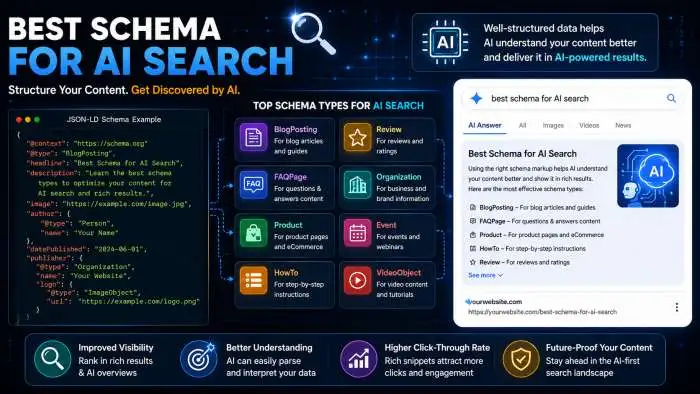
Best Schema Markup for AI Search: How to Get Your Site Cited by LLMs
If you want your content to appear in AI search results, you need to use schema markup. The best schema for AI search is a combination of Organization, Article, FAQPage, and Person schema. These help AI systems like ChatGPT, Google Gemini, and Microsoft Copilot understand...

Easy Digital Marketing Strategy for 2026: Simple Ways to Grow Online
A digital marketing strategy for 2026 is just a well-defined strategy that outlines how you'll achieve your business Goal through online methods and channels. It's the pathway that will help your business reach those who need to know it, and grow your sales. This strategy is centered around who,...

Proven Customer Engagement Strategies to Drive Business Growth
A customer engagement strategy is your plan for building strong relationships with your customers at every step of their journey. It's not just about making a sale. It's about creating real connections that make people feel valued and heard . Think of it as the way you talk...