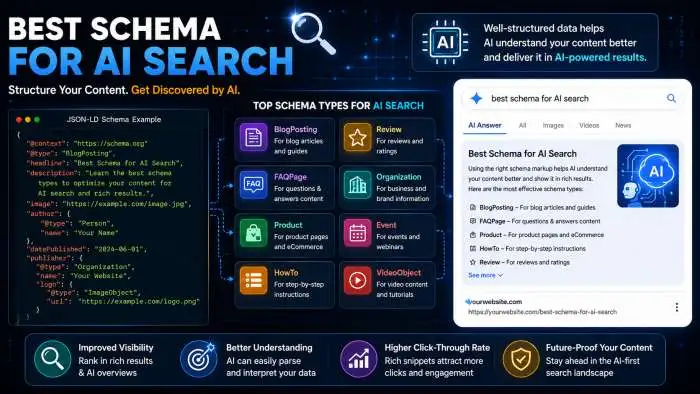
If you want your content to appear in AI search results, you need to use schema markup. The best schema for AI search is a combination of Organization, Article, FAQPage, and Person schema. These help AI systems like ChatGPT, Google Gemini, and Microsoft Copilot understand who you are and what you offer. Experts confirm that well-structured data helps models parse, validate, and surface your content . Pages using schema are far more likely to be cited by AI.
It is not a guarantee, but it is your best bet for being part of the AI conversation. Use JSON-LD format because Google and AI crawlers prefer it .
The Best Schema for AI Search: Understanding the Basics
To get started, you need to know the different types of schema available. Schema is code that helps search engines and AI understand your page. It labels key details so machines do not have to guess. There are hundreds of types, but a few stand out as the best schema for AI search. Using these core types gives you a strong foundation. They make your content clearer and more accessible.
AI systems rely on this kind of clarity. Data from Backlinko shows that 72% of pages on the first page of Google use some type of schema . This shows a clear connection between using schema and ranking high. If you want to reach the top, you must follow this path. It is a simple step that makes a huge difference.
You may also read :- Google Launches AI Agent for Ad Manager
Core Schema Types for AI Visibility

There are several schema types that matter most for AI visibility. These are the must-haves for any site. Here is a breakdown of the core schema types for AI visibility that you should prioritize. They build a picture of your brand and content for AI.
- Organization Schema: This is your business identity. It tells AI your name, logo, and contact details. It helps build trust and feeds into your Knowledge Panel. This is a foundational piece. Every business should use this type.
- LocalBusiness Schema: If you serve a specific area, this is essential. It provides location details like address and opening hours. It helps you appear in local AI-powered searches. This is a must for local SEO.
- Person Schema: This highlights your team members. It connects authors and experts to topics. It strengthens E-E-A-T signals. For professional services, this is very beneficial. It shows you have real people behind the content.
- Article Schema: This defines the main content of your page. It highlights the headline, author, and publish date. AI engines value recency. Accurate dates are essential for getting cited.
- Product Schema: This is vital for ecommerce. It clarifies specs, price, and reviews. It helps your products appear in AI-generated shopping results.
- FAQPage Schema: This wraps question-and-answer pairs. AI engines can directly reference these. It is perfect for surfacing in featured snippets and AI overviews. It directly answers user queries.
- BreadcrumbList Schema: This shows your site structure. It helps AI and users navigate your site. It also makes your site look more reputable in search results.
- Review Schema: This displays star ratings. It provides social proof that AI systems can use. It adds trust signals and helps AI generate recommendations.
Data shows that Organization, BreadcrumbList, and WebSite schema are the most common types found on pages cited by AI . This means using these core types is a smart move. They are the most common because they are effective. By using them, you align with what is already working.
Why JSON-LD is the Recommended Format
How you add schema matters. The format you choose can impact how well AI reads it. Google and most AI crawlers prefer JSON-LD. This is the best format because it sits separately from the visible HTML. It is easy to maintain and deploy at scale.
JSON-LD allows you to add all your structured data in a single block of code. This makes it cleaner and simpler. It is more manageable than other formats like Microdata or RDFa. For AI search, JSON-LD is the clear winner. It is the easiest way to implement and maintain your schema. If you use WordPress, plugins like Yoast SEO and Rank Math make this easy. If you are using other CMSs, you can also add the code manually.
Implementation Best Practices ai Search
Now that you know the types, it is time to implement them. You need to follow best practices to get results. Implementation best practices ai search includes placing the code correctly and keeping it accurate. It is not about just adding any code. It is about adding the right code the right way. This ensures AI systems can find and use your data.
The first step is to decide which schema fits your content best. Most businesses should start with Organization or LocalBusiness schema. Then, you can add Service or Product schema as needed. Matching the schema to the page content is critical. For example, a blog post needs Article schema. An ecommerce page needs Product schema. This makes the data highly relevant and useful.
Implementation Best Practices
1. Choose the Right Schema Type
Start with the basics. Focus on Organization or LocalBusiness schema first. Then, add other markups like Service or Product. Think about what your page is actually about. Match the schema to that topic. For instance, an ecommerce store should use Product schema. A local dentist should use Service schema. This creates a clear link between your content and the schema.
2. Use JSON-LD Format
This is the recommended format by Google. It is the easiest to implement and maintain. You can add it as a single block of code in the <head> section of your HTML. This method is clean and keeps the schema separate from your main content. Using JSON-LD also helps avoid messing up your page's layout.
3. Be Comprehensive and Accurate
Fill in all required fields. Add as many recommended fields as you can. Accuracy is critical. Ensure the information in your schema matches the content on the page. If you have a product page, make sure the price in the schema matches the price on the page. Inaccurate data will harm your trust with AI systems.
4. Audit Regularly
AI systems are always evolving. Your structured data should evolve with them. Audit your schema regularly to ensure it stays accurate and complete. This is especially important after you update your website. Regular checks help you catch and fix any errors quickly.
How to Optimize Content for AI Search?
You also need to think about your actual content. Schema is just one piece of the puzzle. The text on your page is still very important. How to optimize content for AI search involves more than just keywords. It is about structure and clarity.
AI systems break down pages into manageable parts. They carefully assess each part for authority and relevance . They then blend information from multiple sources. This means your content needs to be easy for AI to digest. You must write with a clear structure.
Structure and Formatting for AI
- Align Titles and Headings: Your title, meta description, and H1 should all say the same thing. They should clearly communicate the page purpose. This helps AI quickly understand what the page is about. Consistent messaging is key to clarity.
- Use Descriptive H2/H3 Headings: Each heading should cover one main idea. This creates a clear outline for AI to follow. It helps systems find the specific answer they need. Think of these headings as chapters in a book.
- Write Self-Contained Q&A Blocks: Use question and answer blocks. This makes it easy for AI to quote your page directly. For example, if your page answers a common question, use Q&A format. This matches how people often phrase their prompts.
- Use Short Paragraphs and Lists: Break up long walls of text. Use short paragraphs and bulleted lists. This improves readability for both humans and AI. It also helps AI systems extract key points faster.
- Add High-Quality Images and Video: Support your text with relevant media. AI systems can also bring in relevant images and video . This creates more opportunities for your content to appear. It also improves the user experience.
How to Rank in AI Search Results?
Everyone wants to know how to rank in AI search results. There is no "secret sauce" that guarantees this, but structure and clarity are key . The goal is to make your content "snippable." This means it is easy for AI to pick up and use. Well-structured content is more likely to be selected.
Focus on writing helpful, reliable, people-first content. Google's systems are designed to connect people with useful information . Do not just recycle what others have said. Provide a unique perspective based on your own experience. This is what sets you apart from the competition.
Factors that Influence AI Search Ranking
Traditional SEO still matters. Crawlability, metadata, internal links, and backlinks are still important . They are the foundation of your online presence. However, AI search adds a new layer. Selection increasingly depends on how well-structured and clear each section is. AI systems need to understand the relationship between different parts of your content.
Also, remember that 65% of AI bot hits target content published within the past year . Freshness is a key factor. Keeping your content updated gives you an edge. Regularly review and refresh your older content. Update the publish date and any outdated information.
Schema Markup for LLM and AI Systems

Schema is not just for traditional SEO. It is also for systems like large language models. Schema markup for LLM helps these models connect facts and entities. It helps them understand the relationships between different things on your site. This structured data layer is like a knowledge graph. It connects your brand's entities across your website.
In this new era of search, context is king . Schema gives LLMs the context they need. It allows them to understand content through entities and relationships. This reduces ambiguity and grounds their outputs in fact-based content. Schema markup improves brand presence and perception in Google's AI Overviews. Studies show higher citation rates on pages with robust schema markup .
Connecting Your Entities
Use schema to define the entities on a page. This includes people, products, services, and locations. Establish relationships between those entities. For example, connect a Product to the Organization that sells it. This shows the connection and makes it easier for AI to see the full picture. It builds a reliable framework that AI systems can draw from. This makes your content more discoverable in AI experiences.
Gen AI Search Optimization Strategies
Gen AI search optimization focuses on making your content AI-ready. This goes beyond just adding schema. It involves a strategic approach to your entire web presence. You need to think about what AI systems will do with your content. They will use it to answer questions and solve problems.
Focus on providing answers, not just information. Your content should directly address user intent. Think about the questions your audience is asking. Create content that gives clear, concise answers. This will increase your chances of being cited in AI overviews.
Audit and Improve Your Structured Data
Start by auditing your current structured data. Identify any gaps in coverage. Check if your schema markup is defining relationships within your website . This context is critical for AI inferencing. Use the Search Console report to measure how your content is performing . This helps you see what is working and what needs improvement.
Map your brand's key entities. This includes products, services, people, and core topics. Ensure they are clearly defined and consistently marked up. Build a content knowledge graph by connecting these entities. Integrate structured data into your AI budget and planning. Treat it as a key investment, not an afterthought.
Case Studies and Examples
Looking at examples can help you understand how this works. Many businesses are already using these strategies. Their success shows the value of schema markup. For instance, Bonilla Law uses FAQPage schema on their homepage. They have a dedicated FAQ section. This helps AI systems find their answers and increases their chances of appearing in snippets .
Another example is ecommerce sites. They use Product and Offer schema to show prices and reviews. This helps them appear in AI-generated product comparisons. Companies using Organization schema often see an improved Knowledge Panel. This builds brand authority and trust. It helps AI recognize and verify your brand.
FAQ
What is the best schema for AI search?
The best schema is a combination of Organization, Article, FAQPage, and Person schema. These help AI systems understand your brand, content, and experts. Using these core types gives you a strong foundation. It makes your content more likely to be cited.
Does schema guarantee that my content will appear in AI search results?
No. Schema does not guarantee a citation. However, it makes your content easier for AI to parse, understand, and trust. It removes technical ambiguity so a strong page is not overlooked. Think of it as a requirement, not a guarantee.
Which format should I use for schema markup?
You should use JSON-LD format. It is the format Google recommends. It is simple to deploy through templates. It sits separately from visible HTML. This makes it easier to maintain at large scale.
Is structured data required for AI search?
Structured data is not required, but it is a good idea. Google says it is not a requirement . However, 65-71% of pages cited by AI Mode and ChatGPT use structured data . It has become a baseline for content that AI considers reliable.
How often should I audit my schema markup?
You should audit your schema regularly. AI systems are constantly evolving. You should check your schema after any major website changes. Regular audits help you catch errors. They also keep your data accurate and up to date.
Related Articles

Digital Marketing Strategies For Local Businesses
Most local business owners do not need more marketing advice. They need a clear answer to one question: where should I put my time and money this month so that real people walk through my door or call my phone? The strategies below are built for...

Easy Digital Marketing Strategy for 2026: Simple Ways to Grow Online
A digital marketing strategy for 2026 is just a well-defined strategy that outlines how you'll achieve your business Goal through online methods and channels. It's the pathway that will help your business reach those who need to know it, and grow your sales. This strategy is centered around who,...

Proven Customer Engagement Strategies to Drive Business Growth
A customer engagement strategy is your plan for building strong relationships with your customers at every step of their journey. It's not just about making a sale. It's about creating real connections that make people feel valued and heard . Think of it as the way you talk...