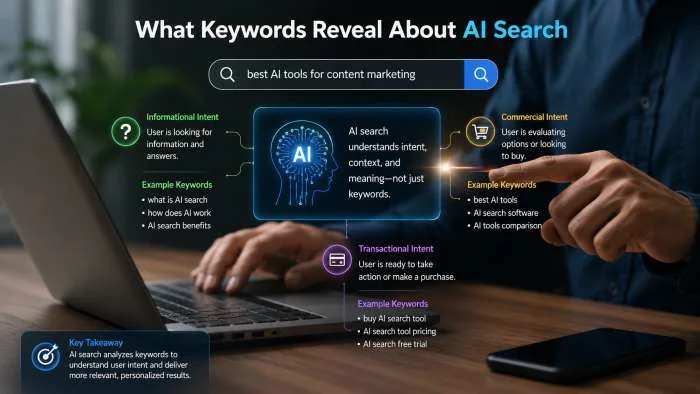
The way people search online has changed. Short three-word searches are becoming less common. Instead, users ask complete questions. They type full sentences into search bars. They describe their problems in detail. What keywords reveal about AI search is that human behavior is shifting. People want direct answers. They want conversational interactions. They want to feel like they are talking to a helpful friend rather than typing into a machine.
This change is not small. Google's own data shows the average AI Mode query is now three times longer than a traditional search . That is a major shift in how we look for information. This article will show you exactly what these changes mean for your business and your online presence.
The Great Keyword Shake-Up
What Keywords Reveal About AI Search: A Data-Driven Look

Big data tells a clear story. A study of over one million keywords showed that 29% of high-volume search demand is declining . This sounds bad at first. But the same study found that nearly the same amount of search volume is growing in other places. Overall demand stayed almost flat. The search volume did not disappear. It just moved to new keywords.
Brands that rely on old keywords are losing ground. Brands that track new keywords are finding new audiences. What keywords reveal about AI search is that demand is being redistributed. It is not vanishing. It is shifting to different terms and phrases.
Where Search Volume Is Growing
Some industries are seeing clear growth. The Lifestyle vertical saw 40% of its keywords growing and only 15% declining . SaaS performed even better with 48% growing and 19% declining. These industries show that people still search. They are just searching differently. They use longer, more specific phrases. They ask questions that AI tools can answer directly.
Where Search Volume Is Falling
Other industries face bigger challenges. HealthTech saw the largest decline at almost 38% . Wellness and FinTech also showed significant drops. Why? These categories are information-heavy. A chatbot can answer a question about drug interactions completely. It can explain an insurance deductible in full. The user gets their answer and never clicks a link. There is no need to visit a website for more information.
You may also read :- Google Zero-Click Searches Hit 68% in 2026: New Study
The Impact of AI on Google Search
How AI Overviews Change User Behavior
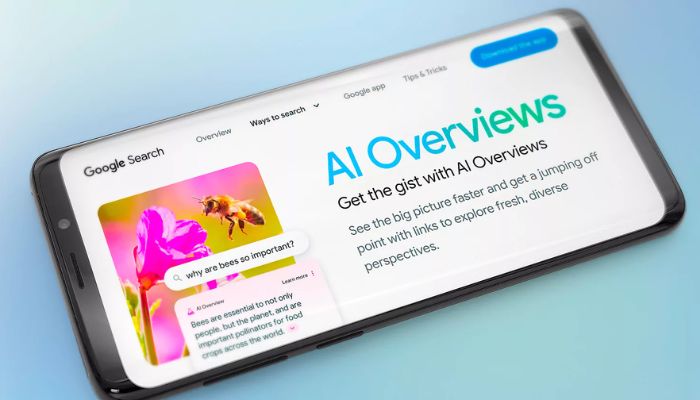
The impact of AI on Google search is visible in user behavior. When Google shows an AI Overview at the top of results, people click less. Organic click-through rates for informational queries fell 61% . Paid click-through rates dropped 68% on those same queries. This shows that AI answers are satisfying user intent instantly. The user does not need to click anywhere else.
The data is clear. Queries that trigger an AI Overview consistently show lower click-through rates than queries without one . This pattern has held steady over many months. It is not a temporary trend. It is a fundamental change in how search works.
What Zero-Click Searches Mean for Your Content
Zero-click searches now account for about 60% of all Google queries . For news-related searches, that number rises to 69%. This means most people get their answer without ever visiting a third-party website. They stay on Google's page. They read the AI summary. They move on with their day.
This has major implications for publishers. Google search traffic to publishers fell 33% globally in the year leading up to November 2025 . Some individual publishers have reported much larger drops. HubSpot estimated it lost 70-80% of its organic traffic. Chegg reported a 49% decline. DMG Media saw drops as steep as 89% for some queries. The impact is real and growing.
Brand Citations in AI Overviews
Not all is lost for brands. Being cited in an AI Overview can provide a boost. Brands that earned a citation in AI Overviews got 35% more organic clicks . They received 91% more paid clicks compared to brands not cited. This suggests that being mentioned in AI answers is becoming as important as ranking at the top of traditional search results.
However, researchers note they cannot definitively prove that citation causes higher click-through rates . It is possible that brands with stronger authority are simply more likely to be cited. The correlation is clear. Brands that appear in AI answers tend to perform better.
The AI Overview Impact on Paid Search
Paid Search in the Age of AI
AI Overview impact on paid search is transforming advertising strategies. Paid search click-through rates could decline by 8-12 percentage points as AI-generated answers take up more space on the search results page . This represents roughly a 20-40% relative drop. Advertisers are facing a more competitive landscape. Fewer clicks are available. Prices are rising.
How Different Industries Are Affected
The effects vary by industry. AI Overviews are appearing more frequently on shorter, high-volume keywords . These are the exact keywords that drive paid conversions. The funnel is compressing. AI Overviews are no longer just a top-of-funnel feature. They are appearing on commercial queries where ad spend is most concentrated.
Finance and Retail see the highest incidence of AI Overviews. Healthcare remains saturated. Automotive and Travel show slower growth but follow the same upward trend . Advertisers in these industries need different strategies. One size does not fit all.
Adapting Your Ad Strategy
Google is weaving ads directly into AI experiences . Advertisers cannot opt out. There is no special campaign type. There is no separate reporting. All performance is collapsed into existing campaigns. This lack of transparency concerns many marketers. They cannot measure exactly how their ads perform within AI Mode or AI Overviews.
The solution is to build your own measurement frameworks. Connect CRM systems more tightly to campaign spend. Track mid-funnel events like demos or downloads. Use marketing mix models to estimate AI's contribution . Do not rely only on Google's data. Build your own understanding.
How AI Is Changing Keyword Strategies
The Shift to Conversational Queries
Google's AI Mode data shows a major behavioral shift. The average AI Mode query is now triple the length of a traditional search query . This single number invalidates many keyword strategies built in 2025. Most SEO teams still optimize for three to four-word keyword targets. These represent a shrinking share of how people actually search.
Follow-up queries in AI Mode have grown more than 40% per month . Users are not landing on one answer and leaving. They are staying in the conversation. They go deeper. They ask more questions. Multimodal interactions now account for more than one in six AI Mode searches. People use voice, images, or video input rather than typed text.
What Users Are Actually Asking
The top five keywords in AI Mode searches are Information, Identify, Find, Explain, and Summarize . The top five opening words are what, how, I, is, and can. People are narrating personal context into the search bar. They are not typing "running shoes for flat feet." They are typing something closer to "I have flat feet and my knees hurt, can you help me find a running shoe that will not make it worse?" .
This is not a keyword. This is a person talking to someone who might actually help them. Content written for short keywords does not serve this kind of search. It is a fundamental mismatch.
The Content Gap Problem
Most content teams are still writing for short keywords. They optimize page titles and meta descriptions for three-word phrases. But AI Mode users ask long, detailed questions. There is a gap between what content provides and what users need.
Brainstorming-related queries have grown 30% faster than the overall pace of AI Mode queries . Planning queries have grown 80% faster. Queries beginning with "which" have grown 40% faster. AI Mode has become a decision-support tool. It is not just a discovery layer anymore. People use it to make everyday decisions.
The Future of Search and SEO
Search Demand Is Redistributing, Not Dying
The numbers show that total search demand is basically flat . The 285,489 declining keywords add up to roughly 10.29 billion in monthly volume. The 140,835 growing keywords add up to roughly 10.31 billion. Net change across the entire dataset is only +16.8 million searches a month. Demand moved. It did not vanish.
Fewer keywords are growing than declining. But the growing ones carry more volume each. That is how the totals end up even. The story is not about search dying. It is about search changing.
Building Authority for AI Visibility
Earned media, credible third-party coverage, and entity signals help brands land in chatbot answers . Digital PR and Generative Engine Optimization (GEO) are increasingly overlapping. To be the answer, you have to build the kind of authority that AI systems recognize.
59% of consumers say they are likely to visit a brand's website after an AI chatbot mentions or recommends it . This is the new conversion funnel. Brand mentions in AI answers are the new rankings. Visits to a brand's website are the new click-throughs. If AI cannot find you, customers will not either.
What Consumers Think About AI Search
Consumer sentiment about AI search is mixed. 33% of consumers trust AI and traditional search equally. 46% trust search more. 20% trust AI more . More than half are at least somewhat skeptical of AI product recommendations. People are happy to let AI filter options. Most still verify before they buy.
Nearly one in five consumers have bought something based on an AI recommendation without checking it against a separate search . This is a new kind of buyer journey. The brand never gets a search-driven touchpoint. To be in the running, you have to be one of the names the chatbot returns.
Conclusion
What keywords reveal about AI search is clear. People search differently than they did even a year ago. They use longer questions. They want direct answers. They stay in AI conversations. They expect personalized help.
Search demand is not shrinking. It is shifting. The brands that win will be the ones that adapt. They will build content for conversational queries. They will earn citations in AI answers. They will create measurement frameworks that go beyond Google's data. They will show up where customers are already looking.
The search landscape has changed forever. The question is not whether to adapt. The question is how quickly you can do it. Start by looking at your keyword data. See where your volume is moving. Build content that answers the questions people are actually asking. Your future visibility depends on it.
FAQs
1. What does keyword data reveal about AI search?
Keyword data shows that search behavior is shifting toward longer, more conversational queries. Short keywords are becoming less common while detailed questions are growing. AI tools satisfy user intent directly, which changes click behavior and traffic patterns.
2. How does AI search affect website traffic?
AI search often reduces traffic to websites. Zero-click searches now account for about 60% of all Google queries. Users get their answers directly from AI overviews and never click through to websites. Publishers have reported traffic drops of 33% or more.
3. What is the difference between SEO and GEO?
SEO (Search Engine Optimization) focuses on ranking in traditional search results. GEO (Generative Engine Optimization) focuses on being mentioned and cited in AI-generated answers. Both are important, but GEO is becoming increasingly critical as AI search grows.
4. How can I optimize my content for AI search?
Write content that directly answers specific questions. Use natural, conversational language. Structure your content clearly with headings and subheadings. Build authority through earned media and credible backlinks. Focus on topics rather than just keywords.
5. Are AI search results accurate?
AI search results are improving but can still contain errors. Research shows the likelihood of chatbots repeating false information has nearly doubled from 18% to 35% over a one-year period. Users should verify important information from multiple sources.
6. Will traditional search engines disappear?
Most experts do not believe traditional search engines will disappear. While AI search is growing, many consumers still prefer traditional search. Over half of consumers say Google will remain their primary search tool in five years. However, the way search works is fundamentally changing.
7. What should advertisers do about AI search changes?
Advertisers should monitor their visibility in AI answers, adapt their ad creative for conversational formats, build their own measurement frameworks, and diversify their acquisition strategies. Do not rely only on paid search as AI changes click behavior.
8. Which industries are most affected by AI search?
Information-heavy industries like HealthTech, FinTech, and Wellness are most affected. Chatbots can answer questions in these categories completely, reducing the need to visit websites. Industries that require transactions or physical products, like SaaS and Lifestyle, show less decline.
Related Articles
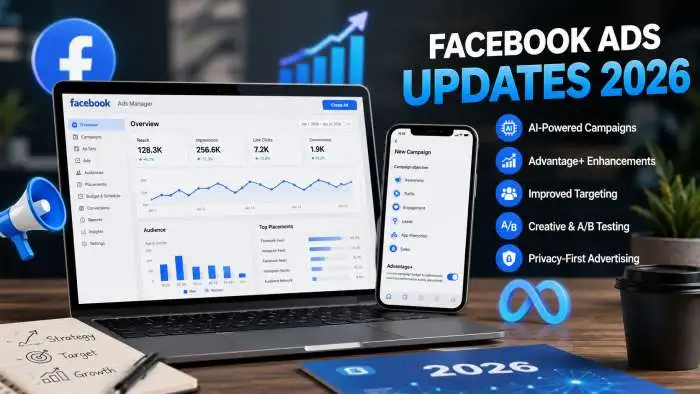
Facebook Ads in 2026: 7 Major Meta Updates You Can't Ignore
The facebook ads updates 2026 focus on artificial intelligence, playful ad formats, and greater control for advertisers. Meta is consolidating targeting options while expanding generative AI tools, introducing AR ads and video polls, and adding new features like profit-based ROAS optimization and dayparting. The platform is shifting toward automated...

Use the New Yoast SEO Bulk Editor to Speed Up Optimization
Managing SEO for a large website often feels like a never-ending task. With hundreds of posts, pages, or products, updating SEO titles and meta descriptions one by one is a huge time drain. The New Yoast SEO Bulk Editor solves this problem by allowing you to manage...
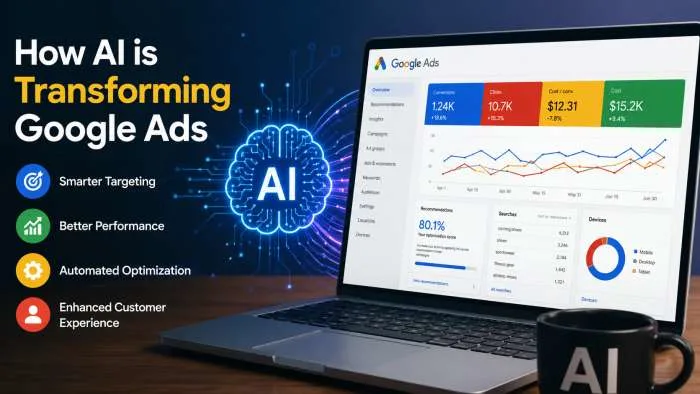
How AI is Transforming Google Ads: The Ultimate Marketer’s Guide
AI is fundamentally changing Google Ads. It moves the focus from manual keyword management to guiding smart systems. This transformation means you now work as a system optimizer, not just a bid manager . The core change involves using AI to improve how you reach customers...