
In the early months of 2026, the B2B marketing world hit a wall. For years, we’ve been told that "content is king," but as AI-generated drafts flooded the LinkedIn feeds and search results of every decision-maker from New York to San Francisco, a new king emerged: Originality.
If you are running a B2B blog today, you’ve likely felt the sting. You publish a 1,500-word piece, and despite "perfect SEO," it sits on page four. Why? Because search engines like Google—and sophisticated "Answer Engines"—have evolved. They aren't just looking for keywords; they are looking for the "Human Fingerprint."
In this guide, we are going to tear down the walls of robotic writing. We’ll explore how to bypass AI detectors, refine your AI bypass prompts, and implement a human-centric workflow that doesn't just "remove" AI detection but replaces it with high-value authority.
Why "Bypass AI Detector" is the Wrong Goal (And What to Do Instead)?
Let’s be honest. If you’re searching for a free AI detection remover, you’re trying to solve a symptom, not the disease.
The "disease" is homogenized content. Most AI models (including GPT-4o, Claude 3.5 Sonnet, and Gemini 1.5 Pro) operate on a mathematical "Next-Token Prediction" framework. They are built to identify and replicate the most statistically probable patterns in language. Humans, however, thrive on "Stochastic Variance."
You can also read this : Best AI Tools for Content Creation in 2026 Guide
We break patterns with non-linear metaphors, deliberate digressions, and raw, first-hand experiences—like the specific chaos of a 2:00 AM server migration or a client’s reaction to a failed campaign—offering contrarian insights that a probability-based model simply cannot simulate.
The Google March 2026 Update Reality
Google’s latest core updates have doubled down on Information Gain. If your B2B blog post simply summarizes what the top 10 results already say, you will be flagged as "low effort," regardless of whether a human or a bot wrote it.
The shift: Stop trying to hide the AI. Start over-indexing on human experience.
The Anatomy of a Robotic B2B Blog Post
Before we fix the problem, we have to identify the "tells" that trigger tools like ZeroGPT or Copyleaks:
- The "In Conclusion" Trap: AI loves formal transitions.
- The Listicle Addiction: Every point is perfectly balanced (e.g., three sentences per bullet).
- Passive Voice Overload: "The strategy was implemented..." instead of "We broke the strategy..."
- Zero Personal Pronouns: A lack of "I," "We," and "In my 10 years of marketing."
- Mastering the AI Bypass Prompt: Beyond "Write Like a Human"
If you tell an AI to "write like a human," it will ironically write the most robotic version of a human possible—overly enthusiastic and full of clichés. Instead, use Structural Constraint Prompts.
The "Friction & Anecdote" Prompt
To get a draft that feels authentic, use this framework:
"Rewrite this section on B2B lead generation. Do not use transitions like 'Furthermore' or 'Moreover.' Instead, start the second paragraph with a specific failure or a common industry myth I’ve likely encountered. Use a mix of very short sentences (under 5 words) and complex, descriptive sentences. Add a parenthetical aside (like this) to offer a quick, witty tip."
The "Contrarian Angle" Prompt
B2B readers want leadership.
"Analyze the current state of SaaS SEO. Take a stance that goes against the common 'best practice' of high-volume keyword chasing. Explain why 'Zero-Volume Keywords' are actually the secret to 2026 conversions. Use the first-person 'we' and include a hypothetical scenario involving a Chief Marketing Officer named Sarah."
The 4-Step "Bypass AI Humanizer" Workflow
You don't need a fancy bypass AI humanizer tool that just swaps synonyms. You need a workflow. Here is the Lyf Dose-approved method:
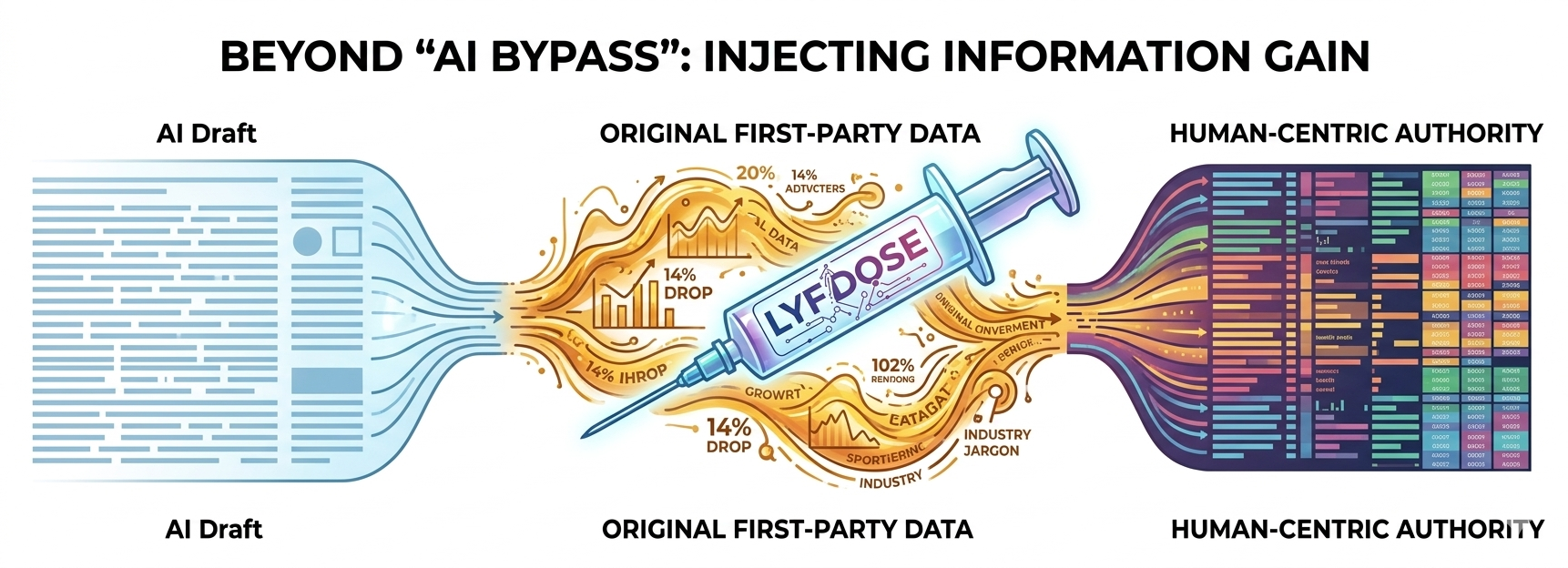
Step 1: The First-Party Data Injection
AI cannot hallucinate your internal data (unless you feed it).
- Tactical Tip: Open your Google Search Console or your CRM. Find a specific statistic unique to your business. "In Q1, we saw a 14% drop in CTR for long-tail keywords, which contradicts the general market trend."
- Why it works: This is a "proof of life" for your content. It provides information that exists nowhere else on the web.
Step 2: The "Burstiness" Audit
"Burstiness" is a metric AI detectors use to measure variance in sentence length and structure.
- The Fix: Read your blog post aloud. If you find yourself breathing at the same intervals every time, the content is too rhythmic. Break a long sentence into three. Merge two short ones. Throw in a rhetorical question. Why does this matter? Because your reader is bored.
Step 3: Use "Micro-Case Studies"
Instead of saying "Mobile marketing increases retention," say "When we implemented push-notification sequences for a Fintech client in New York, we saw a 22% spike in Day-30 retention."
Step 4: The Slang and Jargon Balance
Every industry has "insider" language that AI often uses incorrectly. In B2B marketing, using terms like "MQL-to-SQL velocity" or "Search Arbitrage delta" in a specific, nuanced context shows the reader (and the algorithm) that an expert is at the keyboard.
Technical SEO Structure for 2000+ Word Pillars
When you cross the 2,000-word threshold, you aren't just writing a blog post; you’re building a Topic Cluster on a single page. To rank in 2026, your structure must satisfy both the "Skimmer" (the busy CEO) and the "Deep Diver" (the technical lead).
A. The "Modular Silo" Approach
Instead of a linear narrative, break your content into independent modules. Each H2 should be able to stand alone as a mini-guide. This increases your chances of winning Featured Snippets and appearing in AI Overviews (SGE).
- The "Hook" H2: Address the primary pain point immediately (e.g., "The Cost of Robotic Content").
- The "Evidence" H2: Use data or a technical breakdown.
- The "Implementation" H2: Give them the "how-to" (e.g., "The Human-in-the-Loop Workflow").
How to Handle "Free AI Detection Remover" Expectations?
Let’s address the elephant in the room. Many B2B writers use tools like StealthWriter or HIX Bypass. While these can be helpful for a quick "polish," they often increase the Spam Rate by using weird Unicode characters or grammatically "off" synonyms.
The Lyf Dose Recommendation: Use these tools only as a "smoke test." If they flag your content as 100% AI, go back to Step 1 (Data Injection). Do not rely on them to "fix" your writing. The best AI bypass humanizer is a human editor with a red pen and a strong opinion.
Maximizing "Information Gain" to Beat the Bots
In 2026, Google rewards the "Unexpected Insight."
- AI says: "SEO takes time and consistency." (0% Information Gain).
- A Human says: "SEO in 2026 is actually a battle for 'Citation Velocity.' If AI models aren't mentioning your brand in their summaries, your organic traffic is a vanity metric." (100% Information Gain).
To ensure your B2B blog ranks:
- Interview a Subject Matter Expert (SME): Record a 10-minute Zoom call with your lead dev or sales head. Transcribe it. Use their exact quotes.
- Embed Original Visuals: An AI can’t easily create a custom chart showing your specific ROI growth from last month.

Avoiding the "Spun" Look: Maintaining Quality at Scale
A "Spun" article is one where the meaning is preserved but the vocabulary is tortured.
- Bad (Spun): "The utilization of digital promotional tactics is imperative for business expansion."
- Good (Human): "If you aren't running ads in 2026, you're essentially invisible."
To maintain a minimum spam rate, avoid over-optimizing. Google’s NLP (Natural Language Processing) is smart enough to know that "B2B marketing strategy" and "Business-to-business growth plan" are the same thing. You don't need to repeat the primary keyword 50 times. Aim for a 1-1.5% density.
Conclusion: The Future of B2B Blogging
The irony of 2026 is that the more "advanced" AI becomes, the more we value the "raw." Bypassing AI detection isn't a game of cat and mouse with an algorithm; it's a commitment to being a better resource than a database.
Your B2B blog should be a reflection of your company's unique culture and successes. When you stop looking for a bypass AI prompt and start looking for a better story to tell, the "AI detection" problem disappears. You won't just pass the bot test—you'll win the customer's trust.
Related Articles
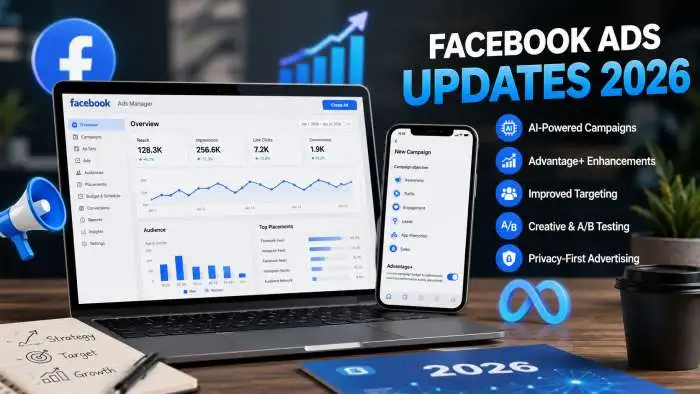
Facebook Ads in 2026: 7 Major Meta Updates You Can't Ignore
The facebook ads updates 2026 focus on artificial intelligence, playful ad formats, and greater control for advertisers. Meta is consolidating targeting options while expanding generative AI tools, introducing AR ads and video polls, and adding new features like profit-based ROAS optimization and dayparting. The platform is shifting toward automated...

Use the New Yoast SEO Bulk Editor to Speed Up Optimization
Managing SEO for a large website often feels like a never-ending task. With hundreds of posts, pages, or products, updating SEO titles and meta descriptions one by one is a huge time drain. The New Yoast SEO Bulk Editor solves this problem by allowing you to manage...
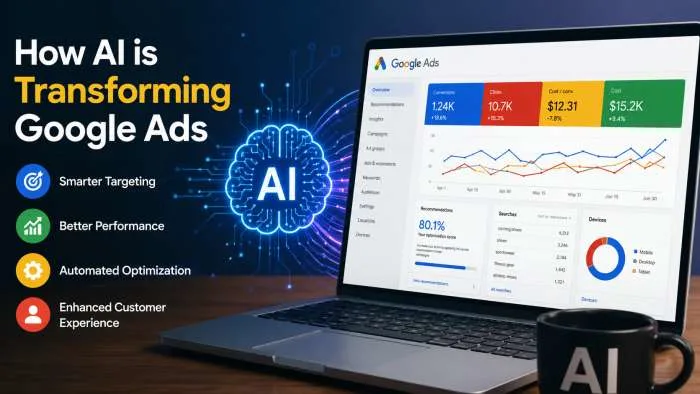
How AI is Transforming Google Ads: The Ultimate Marketer’s Guide
AI is fundamentally changing Google Ads. It moves the focus from manual keyword management to guiding smart systems. This transformation means you now work as a system optimizer, not just a bid manager . The core change involves using AI to improve how you reach customers...