
If you want to know how to optimize for AI search, here is the simple answer: focus on creating clear, helpful, and well-structured content that answers real questions. AI systems like ChatGPT, Google's AI Overviews, and Perplexity look for content that is easy to understand, trustworthy, and directly useful. This means you should write for people first, use clear headings, and back up your points with facts. By following the steps in this guide, you can make your website more visible in AI-driven search results and get your brand cited by these powerful tools.
The way people find information online is changing fast. More and more, people are asking AI tools like ChatGPT and Google Gemini for answers instead of typing keywords into a search bar. In fact, platforms like ChatGPT now see hundreds of millions of weekly active users, and Google's AI Overviews have over 2 billion monthly users .
This is a big shift from how search used to work. In the past, you just needed to rank high on Google's list of links. Now, you also need to make sure your content is picked up and cited by AI systems.
What is AI Search Optimization and Why Does It Matter?
AI search optimization is the practice of making your content easy for AI search engines to understand and use. These AI systems, like ChatGPT, Perplexity, and Google's AI Mode, don't just show a list of links. They read through many sources and then write a single, synthesized answer for the user .
If your content is cited in this answer, you get massive visibility, even if the user never clicks through to your website. This is why it's so important to learn how to optimize for ai search.
This matters because of "zero-click" searches. Around 69% of Google searches now end without a click on a website . Users are getting their answer directly from AI-generated summaries and moving on. However, being cited in these AI answers has huge benefits.
Brands that are mentioned in AI Overviews can earn 35% more organic clicks and 91% more paid clicks . So, while you may not get a click every time, being cited helps build your brand's reputation and drives high-intent traffic later.
The Difference Between Traditional SEO and AI Search Optimization
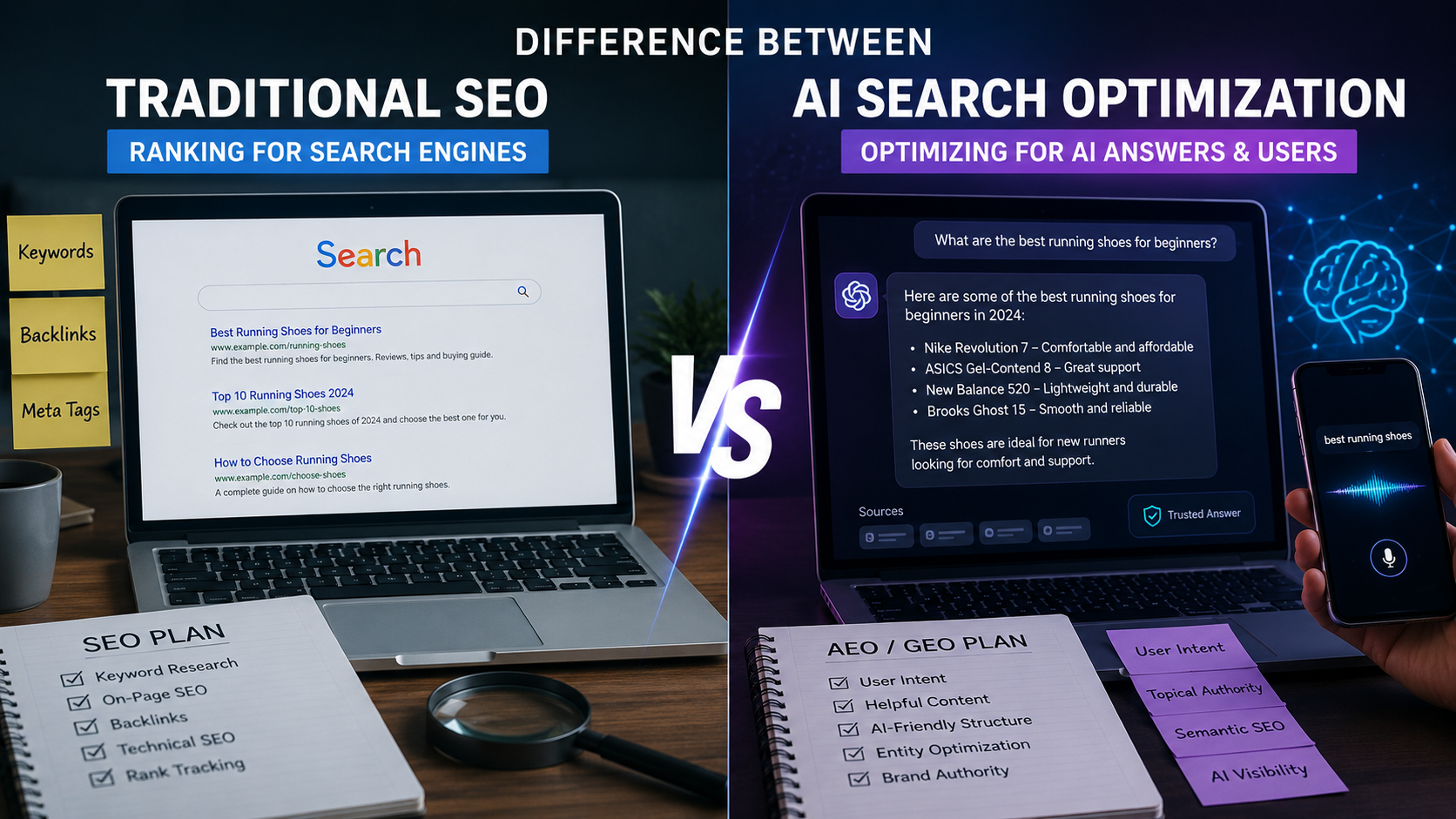
There are many rules of old-school SEO that apply here, but it's a different focus. In their traditional sense, SEO algorithms are concentrated on the keywords, links and the "blue links" of a search engine's results page. The goal of AI search optimization is to be understood. It's about writing content that a bot or AI machine will believe and will use to provide a response to someone's query. The idea is to get it in answers generated by AI, even at the cost of fewer clicks.
Here is a simple breakdown:
| Feature | Traditional SEO | AI Search Optimization |
|---|---|---|
| Goal | Rank #1 on search results pages | Get cited in AI-generated answers |
| Focus | Keywords, backlinks, page authority | Content clarity, answering questions, trust |
| Traffic | Drives traffic to your website | Builds brand awareness and drives later, high-intent traffic |
Google's Official Stance on AI Search Optimization
Google has confirmed that traditional SEO best practices are still the foundation for appearing in their generative AI features . They say you don't need special code or secret tricks. The best way to show up in Google's AI Overviews and AI Mode is to create helpful, reliable, people-first content . So, how to optimize for ai search on Google starts with following their basic SEO guidelines. They also emphasize that there is no need for special markup or "chunking" content into tiny pieces for AI .
You may also read :- SEO Priorities for AI Search: How to Rank in ChatGPT and Perplexity
How to Optimize Your Website for Generative AI Features on Google Search?
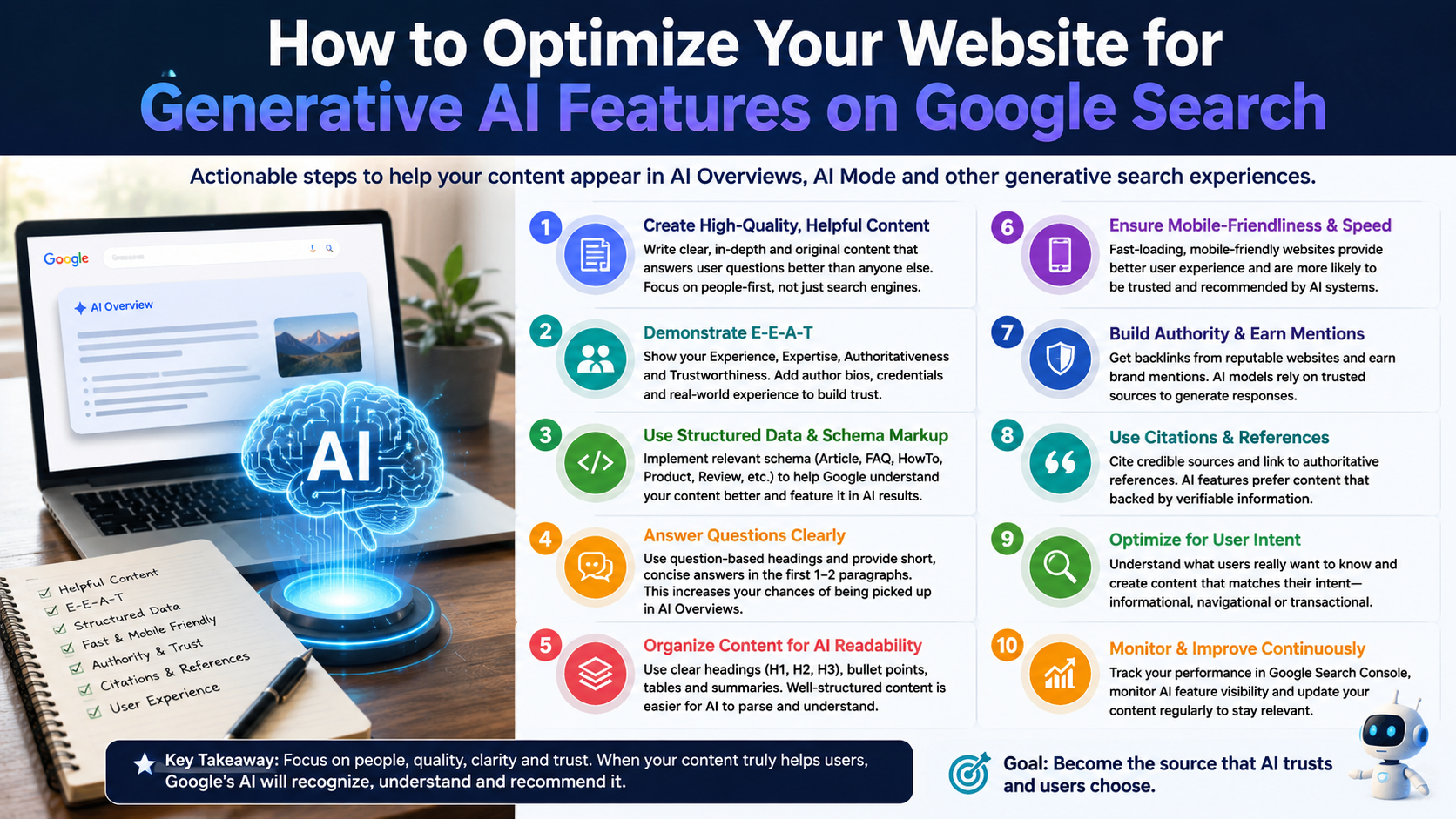
Google has released a guide optimizing your website for generative ai features on google search. Their advice is clear and straightforward. It is not about AI-specific hacks but about doing the fundamentals of SEO really well. Google's AI features, including AI Overviews and AI Mode, are powered by their core search ranking systems. This means if your site is strong in traditional SEO, you are already on the right track.
According to Google, focusing on the user is the most important step . This includes:
- Providing a unique point of view: Share original experiences and expert insights. Don't just summarize what others have said.
- Creating non-commodity content: Go beyond basic tips. Offer deep, valuable, and experience-based information that is hard to find anywhere else.
- Organizing content clearly: Use headings, short paragraphs, and lists to make your page easy to read and navigate.
- Adding high-quality images and video: Visuals help explain concepts and make your content more engaging .
Finally, Google confirms that you can ignore common "hacks" like creating "llms.txt" files or "chunking" content for them. These are not needed for Google Search . This is a critical piece of the puzzle for how to optimize for ai search on Google.
How to Write for AI Search: Creating Content AI Loves
Now that we have the basics, let's get into the practical steps. How to write for AI search is about making your content "extractable." AI systems need to easily find the answer to a question within your text.
1. Start with a Clear, Direct Answer
Your introduction should be a clean and direct answer to the reader's primary question. It's like your "summary.Use it as your "summary". AI systems tend to retrieve this information to use in their answers. If you're writing an article on how to plant tomatoes, for instance, your first paragraph should be a summary of the steps you take. AI loves this.
2. Use a Clear Heading Structure
Using clear H2 and H3 headings is essential how to optimize for ai search. AI models scan these headers to understand the topic of your content. They act like a table of contents for the AI. Use question-based headings that people would naturally ask. For example, instead of "More Info," use "How Do I Improve My Website Speed?" This makes it much easier for AI to connect your content to the right question . This is also the best way to use your primary keyword in an H2 heading.
3. Write in Short Paragraphs and Bullet Points
Long walls of text are hard for both humans and AI to read. AI systems break content into chunks for processing. If your paragraphs are too long, the AI might lose context . Stick to 2-3 sentences per paragraph. When you have a list of points, use bullet points. This format is easier for AI to scan and summarize, which is a key part of ai search optimization .
4. Answer Questions Directly with FAQs
Including an FAQ section is one of the most effective ways to perform how to optimize for ai search. AI systems are built to look for clear, concise answers, and FAQs provide this in a perfect format . When you write an FAQ, imagine a person asking the question and then answer it in 1-3 sentences. This structure is like a direct invitation for AI to pull your content for their answers.
5. Use Facts, Statistics, and Citations
AI systems value authority. They are more likely to cite your content if it is backed up by facts and figures. Research shows that adding statistics to your content can improve your visibility in AI search by 33% . Mentioning other authoritative sources also helps. It shows that your content is well-researched and trustworthy.
6. Write in a Conversational, Natural Tone
AI models are built for conversation. Writing in a natural way that sounds like a person talking is very effective for how to write for AI search. Focus on answering the questions people are actually asking. Swap generic keywords for natural language questions. For example, instead of "AI optimization," write "How can I make my site appear in AI search?" . This aligns perfectly with how AI processes language.
Advanced Techniques for AI Search Optimization
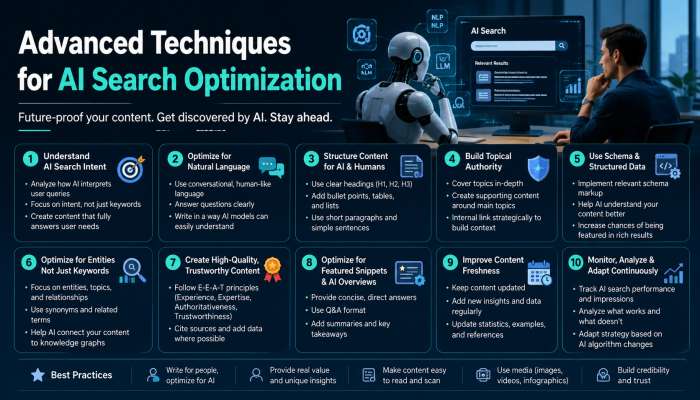
For those ready to go a step further, here are some more advanced strategies.
The Power of Brand Mentions
New research shows that how often your brand is mentioned across the web is a huge factor in AI search optimization. A study by Ahrefs found a very strong correlation (almost 0.67) between a brand being mentioned on many websites and that brand being mentioned in AI conversations . This is different from traditional backlinks. It means getting your brand name out there on forums, blogs, and news sites is more important than ever for AI search visibility.
Optimizing for Perplexity vs. ChatGPT
Different AI models have different preferences, which impacts how to optimize for ai search on each platform.
- ChatGPT: Prefers well-structured explanations from trusted, authoritative sources. It may not always show a link, but if your domain has authority, you will be cited more often.
- Perplexity: Always shows citations and favors recent, factual, and media-rich content. Including charts, visuals, and videos can give you an edge .
The Role of Structured Data
While Google has said there is no special Schema.org markup needed for their AI features, structured data is still a good idea . It helps all search engines understand your content better. For example, using FAQ schema can help your FAQ section appear in rich results, which can improve your click-through rate and potentially your AI visibility.
Busting Myths: What You DON'T Need to Do for AI Search
There is a lot of bad advice out there about how to optimize for ai search. Let's clear up some common myths.
-
Myth: You need to "chunk" your content into tiny pieces for AI.
-
Fact: You do not need to break your content down into small chunks for AI. Google's systems are advanced enough to understand the nuance of multiple topics on a single page .
-
-
Myth: You need a special "llms.txt" file.
-
Fact: Google has clearly stated that they do not use "llms.txt" files or any other special markup for their AI features .
-
-
Myth: You need to rewrite all your content just for AI systems.
-
Fact: You don't need to write in a specific way just for AI. AI systems are good at understanding synonyms and the general meaning of content. Just write for your human audience .
-
Measuring Your Success in AI Search
A key part of how to optimize for ai search is tracking your progress. For Google Search, you can use the "Generative AI performance report" in Google Search Console . This report shows you how your content is performing in AI Overviews and AI Mode.
For other AI platforms like ChatGPT and Perplexity, you can use tools to audit your site. Some tools score your website's AI-readiness by checking for things like robots.txt settings, structured data, and content clarity . Others allow you to query AI models directly to see if your brand is mentioned . These AI search optimization tools can provide valuable insights.
Conclusion: Your Action Plan for AI Search Success
The key takeaway is that how to optimize for ai search is not about magic tricks. It is about doing the fundamentals of good content creation exceptionally well. Here is your final checklist:
- Write for People First: produce content that is genuinely helpful, reliable and has a unique perspective.
- Structure for Success: Organize with clear headings, short paragraphs and bullet points.
- Answer the Questions: Add an FAQ section that answers common user questions in a concise and direct manner.
- Construct Authority: Support statements with facts and statistics and citations.
- Track Your Progress: See what works with Google Search Console's AI performance report and other tools.
By adhering to these basic tips, you can learn to optimize for ai search and make sure your content is discovered, comprehended, and referenced by AI. This will help you to connect with new audiences and develop your brand in the ever-changing realm of search.
Frequently Asked Questions
1. Is AI search optimization the same as traditional SEO?
No, but they are closely related. Traditional SEO focuses on ranking in search results to get clicks. AI search optimization focuses on making your content so clear that AI systems use it in their synthesized answers, which builds your brand's authority. Traditional SEO forms the foundation for AI search optimization .
2. What is the most important thing to do for AI search optimization?
The most important step is to create valuable, non-commodity content that provides a unique perspective and answers user questions directly . If your content is not helpful or unique, AI systems are less likely to cite it. Focus on giving your audience what they really want.
3. Do I need to use AI tools to optimize for AI search?
AI tools can be helpful for analyzing your content and finding gaps, but they are not required. You can start by simply writing clear, well-structured, and helpful content. Many AI search optimization tools are available for auditing your site, but the core strategy is about improving the quality of your writing.
4. How do I know if my content is being used by AI?
You can use Google Search Console to see how your site performs in Google's AI Overviews and AI Mode . For other AI platforms, you can manually ask ChatGPT or Perplexity questions related to your topic to see if your brand is cited. There are also third-party tools that can help you track AI citations .
5. Does Google require special code like "llms.txt" for its AI features?
No. Google has explicitly stated that you do not need to create special machine-readable files, markup, or "llms.txt" files for their generative AI features. The best approach is to follow their existing SEO best practices and focus on making great content .
Related Articles
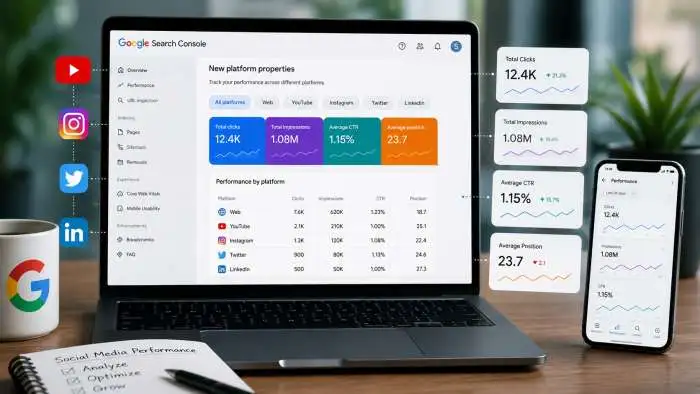
Track Your Instagram, TikTok and YouTube Traffic in Google Search Console
Imagine seeing exactly what people search for on Google before they find your TikTok video or Instagram Reel. That is now possible. Google's new platform properties for Search Console give you this superpower. This feature connects your social media accounts to Search Console. You can...

Local GEO Baseline Audit Guide: Benchmarking AI Visibility
Are you invisible to AI? A local GEO baseline audit shows exactly how AI tools like ChatGPT, Gemini, and Perplexity see your business. This audit is the starting point for all your AI search efforts. You will benchmark your current visibility, find data errors, and learn how...

How to Build an AI Content Strategy That Actually Ranks and Converts
An effective ai content strategy means creating content that answers user questions directly and clearly so AI systems can easily find and cite it. This approach helps you show up in AI Overviews and other AI-powered search results. The goal is to become the go-to source for...