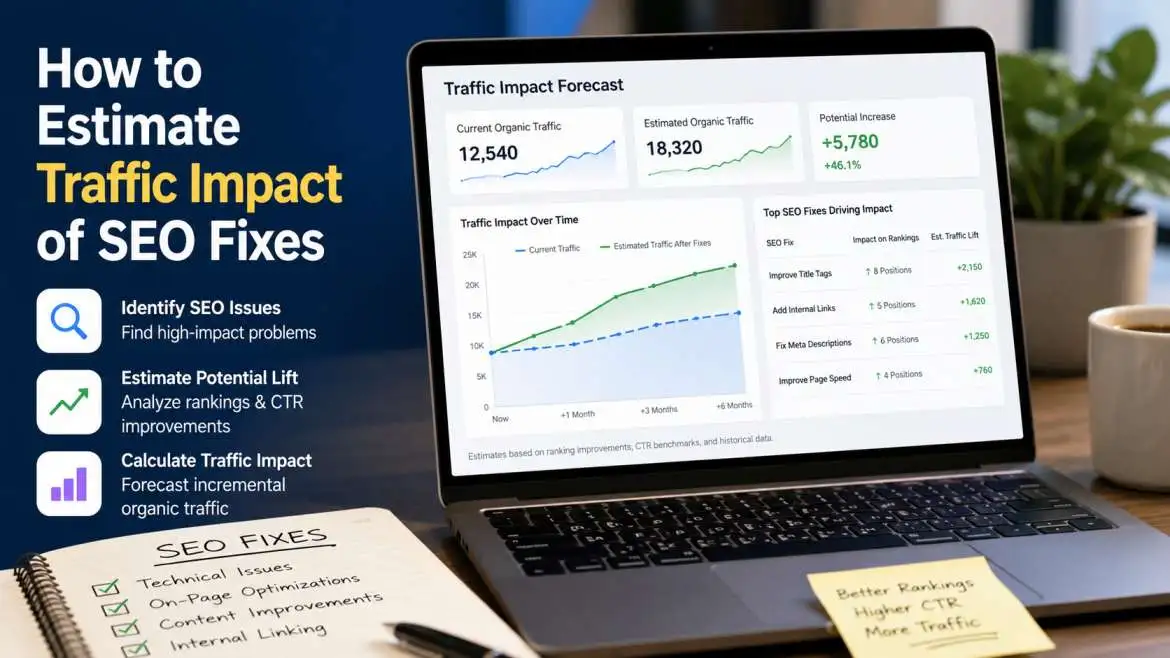
You’ve spent weeks auditing a site. You found the technical debt, the broken internal links, and the content gaps. But when you hand that spreadsheet to the leadership team, they don’t see the engineering effort. They see a cost center. To get your dev tickets prioritized, you need to answer one brutal question: What is this going to get us?
If you want your budget approved, you have to estimate traffic impact of SEO fixes before the first line of code is ever changed. When you can clearly show how fixing a few broken links or cleaning up site code actually turns into real clicks, the whole conversation changes. You're not begging for budget or trying to justify SEO as some mysterious expense anymore. Instead, you're pointing directly to the revenue the business is actively missing out on.
How to Estimate SEO Traffic Impact?

For too long, organic forecasting has been treated like a parlor trick. We look at historical growth curves, slap a conservative 10% increase on top, and pray we hit the mark. That doesn't work anymore. Modern search engines are too volatile, and executive teams are too smart for guesswork.
To truly measure SEO improvements ahead of time, you need to dissect your data into three distinct layers: current performance baseline, addressable search volume, and realistic click-through rate (CTR) gains.
You may also read :- 8 GEO Metrics to Track in 2026: The New Way to Rank in AI Search
Step 1: Establish Your Clean Baseline
Before looking forward, look backward. Pull the last 12 to 24 months of performance data from Google Search Console (GSC) and Google Analytics 4 (GA4).
- Filter out brand terms. Brand traffic skews your data and hides real organic performance shifts.
- Account for seasonality. A summer dip isn't an SEO failure if it happens every July.
- Isolate historical anomalies, like broad core algorithm updates or tracking errors.
Step 2: Calculate the Total Addressable Share (TAS)
You cannot capture 100% of the volume for a keyword. Paid ads, AI overviews, local packs, and people-also-ask features constantly erode organic real estate. Your traffic potential calculation must factor in the actual layout of the Search Engine Results Page (SERP).
Look at your target keyword clusters. Are they heavily monetized with shopping ads? If so, even a ranking of position one won't yield historical CTR averages. You must adjust your addressable volume downward based on SERP crowding.
Step 3: Run the CTR Uplift Model
When you fix an SEO issue, your rankings move. When rankings move, your CTR shifts. To model this, map out your current CTR curve by position for your specific site. Do not use generic industry benchmarks. Your site’s layout, brand authority, and meta descriptions mean your CTR curve is entirely unique.
Once you have your custom curve, model the shifts. What happens if your technical optimizations move a cluster of 50 high-value keywords from position 8 to position 3? By applying this formula across your targeted keyword buckets, you can cleanly calculate traffic increase from SEO improvements.
Categorizing the Technical Debt: What Do the Fixes Actually Yield?
Not all search engine optimization tasks are created equal. A fix to your robots.txt file behaves completely differently than a rewrite of your thin content. If you want to accurately calculate how SEO changes impact on traffic, you have to understand the specific mechanics of how different technical updates move the needle.
Core Web Vitals and Page Speed
Let's be real about speed fixes. Knocking out a Cumulative Layout Shift (CLS) issue or tightening up your Interaction to Next Paint (INP) isn't going to magically double your traffic by tomorrow morning. It just doesn't happen. In reality, Core Web Vitals act more like an algorithmic tie-breaker.
Picture this: You’re locked in a brutal, page-for-page battle with your top competitor, and both of your content strategies are equally stellar. Who gets the edge? The faster, smoother site. Every single time. If your pages already rank halfway decent, cleaning up performance bottlenecks usually coaxes a modest 2% to 5% bump in clicks. The real payoff, though? Watch your on-page conversion rates start climbing when users stop fighting a lagging interface.
Crawl Budget and Indexation Fixes
This is where the massive wins hide, especially for large enterprise sites or e-commerce platforms with millions of faceted navigation URLs. If Googlebot is wasting 70% of its time crawling duplicate filter pages, your money-making pages are starving for attention.
Fixing indexation issues—like implementing proper canonical tags, clean noindex directives, or trimming dead weight—reclaims your crawl budget. When Google stops wasting time on junk, it indexes your updates faster and passes equity to your core landing pages. For bloated sites, cleaning up indexation can cause sudden traffic spikes of 20% to 150% as your primary pages finally get crawled properly.
Information Architecture and Internal Linking
If you clean up that mess and group your pages into tight, logical categories, everything changes. Every subpage instantly gets a boost from its parent category. Fix your broken internal links, use descriptive anchor text, and you finally distribute that authority to the pages that need it. When you run your numbers to see what these structural changes will pull in, keep your eyes on your deep product or service pages. You won't just see one page jump; you'll see a massive wave of traffic across hundreds of random long-tail keywords all at once.
Advanced Modeling: Building Your Traffic Forecasting Engine
We need to build an interactive tool to take these concepts off the page and put them into practice. Static numbers don't show the full picture. If you want to see exactly how adjustments to your traffic baselines, rankings, and SERP real estate change your outcomes, use the model below. You can tweak the monthly search volume, current rankings, and target positions to instantly see your estimated traffic lifts.
Aligning Search Intent with Rank Stability

Data models are beautiful, but they lack human intuition. A mathematical model assumes that if you hit position two, you will stay there. Search engine algorithms don't work that way anymore. They rely heavily on real-world user satisfaction signals. If your page ranks well but fails to answer the user's implicit question, your bounce rate climbs, your dwell time drops, and your rankings collapse.
To ensure your predicted SEO changes impact on traffic actually hold long-term, you must align your content with the true intent of the searcher.
The Four Buckets of Intent
- Informational: The user wants an answer. ("how to estimate SEO traffic impact")
- Navigational: The user wants a specific site. ("Google Search Console log in")
- Commercial Investigation: The user is comparing options. ("best technical SEO tools")
- Transactional: The user is ready to buy. ("Ahrefs subscription discount")
If you optimize a page for a commercial keyword using a purely informational blog post format, you might see a temporary ranking bump due to technical optimization. But it won't last. The user will click, realize they can't browse options easily, and head straight back to the search results.
When mapping out your forecasting, only apply your target CTR uplift models to keywords where your landing page template genuinely matches what the user is looking for. Anything else is built on sand.
De-Risking the Forecast: Managing Executive Expectations
The biggest mistake an SEO can make is presenting a forecast as an absolute guarantee. Search engine marketing operates in a dynamic ecosystem. You don't control Google’s algorithm updates, and you certainly don't control your competitors' budgets. If a major competitor launches a massive backlink campaign next month, your projections will miss the mark through no fault of your own.
To protect your credibility, always present your forecasts using a three-tiered probability matrix.
| Forecast Scenario | Confidence Level | Core Assumptions | Expected Traffic Growth |
| Conservative (Base) | 90% | Technical fixes implemented; core algorithm remains stable. Competitors don't react. | +5% to +10% |
| Expected (Target) | 70% | Core technical and content updates completed on time. Improved internal linking patterns. | +15% to +25% |
| Aggressive (Optimistic) | 40% | Competitors lose ground; search engine core updates favor our site architecture changes. | +30% to +50% |
By presenting your traffic potential calculation within these guardrails, you shift the executive perspective. They stop viewing your forecast as a rigid promise and start understanding it as a strategic risk-mitigation framework. You protect your team while still providing a clear path toward significant organic returns.
Frequently Asked Questions
How do you accurately estimate traffic impact of SEO fixes?
To estimate traffic impact, establish a non-branded traffic baseline using Google Search Console, calculate your current CTR per ranking position, and model the projected ranking improvements across your target keyword clusters. Factor in SERP feature crowding to discount lost clicks before launching updates.
How long does it take to see traffic changes after making SEO updates?
If you just cleared out a massive indexation bottleneck—like killing off a rogue noindex tag or fixing broken canonicals on your top money pages—Google can pick that up in a few days. You'll see the spike fast.
But if you completely overhauled your site architecture or did a massive content rewrite across hundreds of pages? Sit tight. That takes time. Expect 4 to 12 weeks for search engines to recrawl, process the changes, and adjust your topical authority across the board.
Why did our organic traffic drop right after we fixed our technical SEO issues?
When you make major structural changes—like updating redirects or changing canonical tags—you throw Google’s index into a bit of a tailspin. The search engine bots have to re-evaluate the entire playground. This usually triggers a week or two of pure volatility where rankings bounce up and down while the index stabilizes.
The real danger zone? Double-check your setup. If that dip lasts longer than two weeks, make sure your redirects are mapped clean and 1:1, and ensure you didn't accidentally cut off an internal link pathway that was passing massive equity to your core pages.
Can you calculate traffic increase from SEO improvements using third-party tools alone?
No. Tools like Ahrefs or SEMrush provide excellent competitor intelligence but rely on generalized click-through click models and scrape data on fixed schedules. To accurately measure SEO improvements and make projections, you must blend third-party data with your site’s actual first-party performance records from GSC.
Related Articles
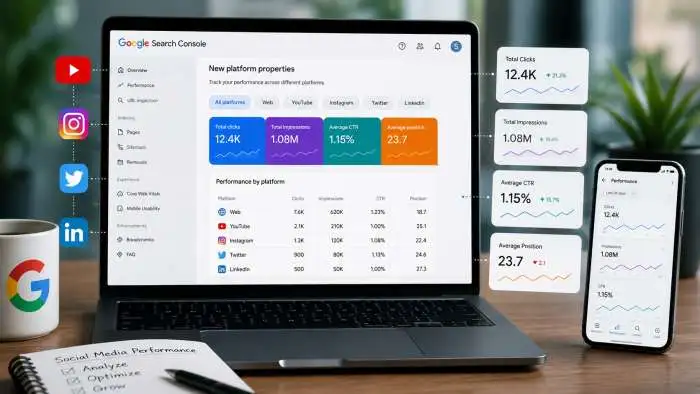
Track Your Instagram, TikTok and YouTube Traffic in Google Search Console
Imagine seeing exactly what people search for on Google before they find your TikTok video or Instagram Reel. That is now possible. Google's new platform properties for Search Console give you this superpower. This feature connects your social media accounts to Search Console. You can...

How Do You Optimize for AI Search? Essential Strategies Explained
If you want to know how to optimize for AI search, here is the simple answer: focus on creating clear, helpful, and well-structured content that answers real questions. AI systems like ChatGPT, Google's AI Overviews, and Perplexity look for content that is easy to understand, trustworthy,...

Local GEO Baseline Audit Guide: Benchmarking AI Visibility
Are you invisible to AI? A local GEO baseline audit shows exactly how AI tools like ChatGPT, Gemini, and Perplexity see your business. This audit is the starting point for all your AI search efforts. You will benchmark your current visibility, find data errors, and learn how...