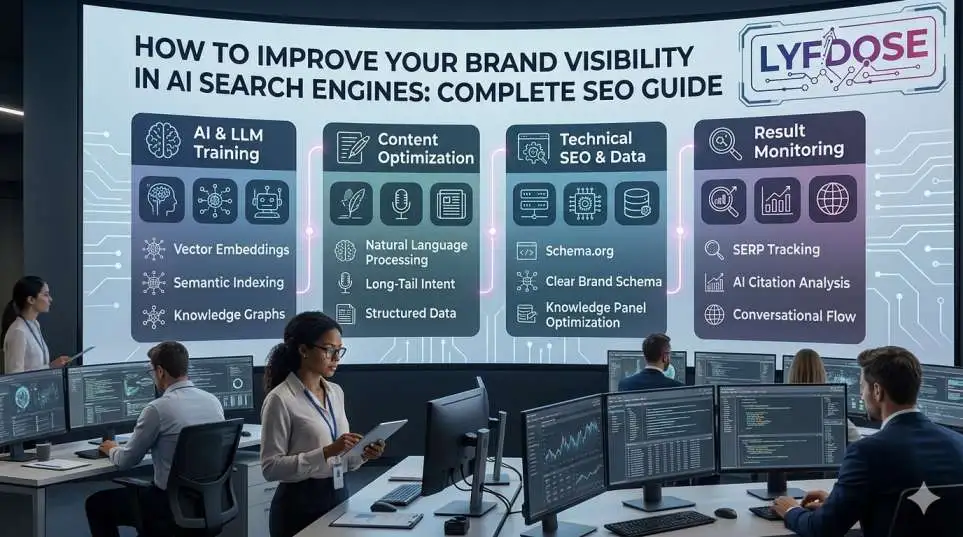
The way people find information has changed. Instead of typing short keywords into a search bar and clicking on a list of blue links, people now ask complete questions to AI systems like ChatGPT, Gemini, and Perplexity. These platforms do not just show websites; they read the web, find the best information, write a summary, and name their sources.
If your brand is not named in those summaries, you are losing customers. This guide will show you how to improve your brand visibility in AI search engines using simple, real-world steps.
What is AI Search Visibility?
AI search visibility is how often and how well your brand is mentioned and cited when an AI assistant answers a user's question.
In traditional search engine optimization (SEO), your goal is to rank your website page on the first page of Google. In generative AI search optimization (often called GEO, AIO, or AI search optimization), your goal is to be the source that the AI trusts, uses, and links to.
To do this, we must understand how these systems work. Modern AI search engines use a process called Retrieval-Augmented Generation (RAG).
Instead of relying only on old training data, the AI takes a user's question, searches the live internet for top-ranking pages, reads those pages, and then summarizes the answer.
If your website is easy to read, highly trusted, and ranks well on search engines like Google and Bing, the AI is much more likely to find your brand, use your facts, and link back to your site. This process of getting selected by an AI is called citation mining.
You may also read :- The Exact SEO Competitor Analysis That Gets #1 Rankings
What Impacts AI Visibility?

Many business owners are confused about why their brand does not show up in AI chat answers. AI engines do not select brands by accident. Instead, they look at several key signals to decide which businesses to trust and recommend.
Here are the main things that influence whether an AI search engine mentions your business:
1. Online Brand Mentions
The more your brand is discussed across the web, the more likely an AI is to talk about you. In fact, research shows that brands holding a 25% share of online conversations get over ten times more citations in AI summaries compared to quieter competitors.
2. Trustworthy, Expert Content
AI engines try to share safe, accurate information. They look for websites that show real experience, deep expertise, clear authority, and overall trustworthiness. High-quality content written by true experts is much more likely to be used as an AI source.
3. Data, Quotes, and Clear Sources
Numbers and proof matter to AI. Adding clear statistics, expert quotes, and official source links to your articles makes your content highly useful. AI programs love using these elements because they make the AI's final answer look more factual.
4. Simple Coding (Structured Data)
Adding organized code, like schema markup, to your website is like putting labels on a file folder. It helps AI systems understand exactly what your pages are about so they can cite your business accurately.
5. Up-to-Date Information
AI assistants value fresh information, especially for topics that change quickly. In fact, studies show that AI platforms tend to pick sources that are 25.7% newer than the sources chosen by traditional search engines.
How to Test Your Brand's AI Visibility
Before you start changing your website, you need to know your current standing. You can find out by running an AI visibility review to see how often different engines point to your business.
During this check, you should look at four main areas:
- Mention Tracking: Count how many times different AI engines name your business in their answers.
- Citation Tracking: Keep a record of which pages on your website the AI links to as trusted sources.
- Semantic Analysis: Find out what the AI thinks of your business. Does it describe your brand in a positive, negative, or neutral way?
- Knowledge Graphs: Check if your business is recognized as an official entity in the large public databases that AI models use to study the world.
Step-by-Step: How to Improve Your Brand Visibility in AI Search
To make your brand easy for AI-powered search engines to find, trust, and recommend, follow these simple steps.
Step 1: Target Bottom-of-Funnel and Comparison Queries

AI search engines are excellent at answering simple, informational questions on their own. If someone asks, "What is photosynthesis?" the AI will explain it without needing to recommend a specific brand.
Because of this, you should focus your content on bottom-of-funnel queries where users are looking to buy or make a decision. This is where search intent optimization becomes critical.
Create content that targets:
- Comparison queries: "Brand A vs Brand B" or "Alternatives to Brand X."
- Best-of lists: "Best accounting software for small retail shops in 2026."
- Specific use-case queries: "How to automate client onboarding using simple tools."
When you write about these topics, you show the AI exactly who your product is for, what problems you solve, and how you compare to others.
Step 2: Use Simple, Direct, and Information-Dense Language
AI models are trained to process natural language. They do not need complex words or confusing industry jargon. To make your content match how AI models read:
- Put your answers first: Do not bury your main point under three paragraphs of introduction. Start each section with a direct, clear answer.
- Increase your information density: Fill your pages with real data, concrete statistics, and clear facts. AI search engines love sourcing statistics because they make the AI's final answer look more credible.
- Write short paragraphs: Keep your paragraphs to two or three sentences. This makes it easy for AI crawlers to scan and copy your text.
Step 3: Build Your Brand Entity Across the Web
AI engines do not just read your website; they look at the whole internet to find out if your brand is real and trusted. This is called entity-based SEO.
The AI treats your brand as an "entity" (a unique, real-world object or business). To make your entity stronger:
- Keep your business details identical: Make sure your brand name, address, and contact details are exactly the same on Google Business Profile, Apple Maps, Yelp, and social media.
- Earn off-site brand mentions: Get featured on respected industry news sites, directories, and blogs. When other trusted sites mention your brand, the AI links those mentions together and views your brand as an authority.
- Get on key review platforms: AI tools look at customer reviews to measure quality. Maintain a strong rating (above 4.0 stars) and reply to your reviews. Active profiles show the AI that your business is open, healthy, and helpful.
Step 4: Use Structured Data for AI
To help search robots read your pages without confusion, you must use structured data for AI search. Structured data (also called Schema markup) is a simple, hidden code you add to your website. It tells search tools exactly what your content means.
You should implement:
- Organization Schema: Tells the AI who you are, what your logo is, and where your social media profiles are.
- Product Schema: Gives the AI clear, organized data about your pricing, product features, and reviews.
- FAQ Schema: Helps the AI quickly pull direct questions and answers for its chat results.
Using these technical signals is a key part of semantic search SEO, helping machines understand the exact relationships between your content and real-world topics.
Advanced Strategies to Get Cited by ChatGPT and Perplexity
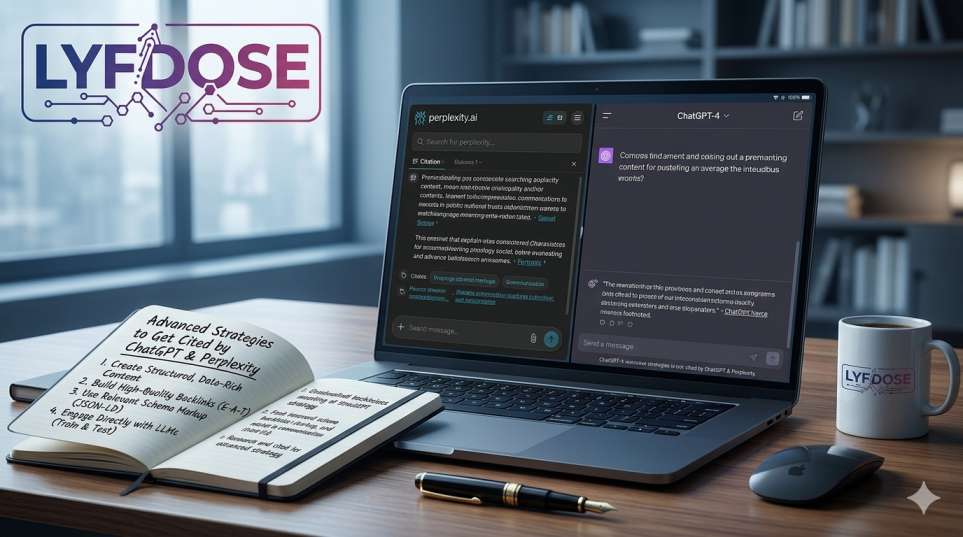
If you want to win top citations on specific AI platforms, you need to tailor your plan to how they operate.
How to Rank in Perplexity Search
Perplexity acts like an extremely fast research assistant. It prioritizes three main elements: speed, recent news, and public discussion.
- Keep your content fresh: Perplexity prioritizes new information. Update your key pages and statistics every month. Pages updated in the last 30 days get significantly more citations.
- Publish original data: Create and share original surveys, charts, or industry reports. Perplexity frequently searches for and cites original research.
- Engage on community platforms: Perplexity frequently crawls and cites discussions from forums like Reddit. Participating honestly in discussions about your industry can lead to indirect AI traffic.
How to Rank in ChatGPT Search
ChatGPT relies heavily on very high-authority sources and well-established internet databases.
- Optimize for Wikipedia and official guides: ChatGPT frequently uses Wikipedia and academic sources for general knowledge. While you cannot easily write your own Wikipedia page, you can focus on building a strong digital footprint so that your brand name is associated with your niche.
- Target Google's Top 3: Research shows a very strong connection between Google and AI engines. If your page ranks in Google’s top three organic spots, it has an 82% chance of being used as a source by ChatGPT. Traditional SEO is still the foundation of LLM optimization.
Prioritizing E-E-A-T for AI Search
AI systems are designed to avoid sharing fake news, bad advice, or untrustworthy products. To protect users, their algorithms look for strong E-E-A-T optimization signals: Experience, Expertise, Authoritativeness, and Trustworthiness.
To build trust with AI models:
- Highlight real people: Include clear author bios on your blog posts. Link these bios to the authors' LinkedIn profiles or professional portfolios to show the AI that a real human expert wrote the content.
- Showcase your credentials: If your business has won awards, earned certifications, or been featured in major news publications, list them clearly on your homepage and "About Us" page.
- Provide clear citations: When you make a claim or share a statistic, link to the official study or primary source. AI models trust writers who cite their sources responsibly.
Action Plan: Your Checklist for AI Search Visibility
Use this simple, weekly checklist to start optimizing your brand for the future of search:
- Audit your brand online: Ask ChatGPT, Perplexity, and Gemini questions about your product category. Note if your brand is mentioned, and look at which of your competitors are getting cited.
- Fix your business listings: Make sure your business name, address, phone number, and website link are identical across all directories.
- Rewrite key pages for clarity: Go to your top five most important pages. Ensure the first sentence of every section directly answers a common customer question.
- Check your technical setup: Ensure your website's
robots.txtfile does not block AI crawlers likeGPTBotorPerplexityBot. - Update your reviews: Check your review scores on Google, Yelp, or industry-specific sites, and reply to your recent customer feedback.
Related Articles
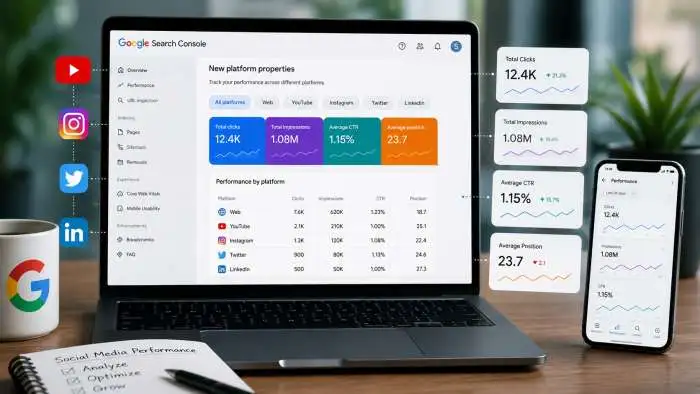
Track Your Instagram, TikTok and YouTube Traffic in Google Search Console
Imagine seeing exactly what people search for on Google before they find your TikTok video or Instagram Reel. That is now possible. Google's new platform properties for Search Console give you this superpower. This feature connects your social media accounts to Search Console. You can...
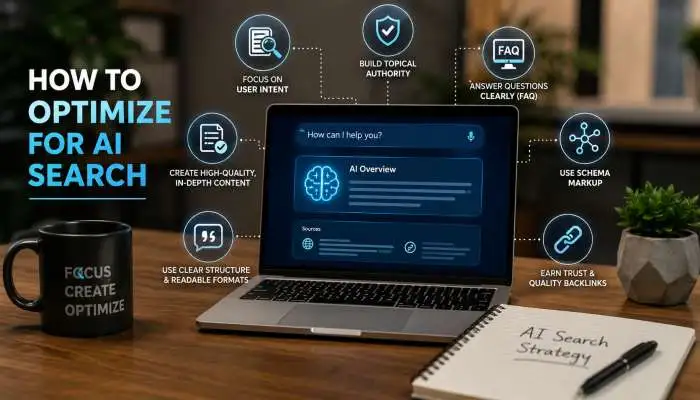
How Do You Optimize for AI Search? Essential Strategies Explained
If you want to know how to optimize for AI search, here is the simple answer: focus on creating clear, helpful, and well-structured content that answers real questions. AI systems like ChatGPT, Google's AI Overviews, and Perplexity look for content that is easy to understand, trustworthy,...

Local GEO Baseline Audit Guide: Benchmarking AI Visibility
Are you invisible to AI? A local GEO baseline audit shows exactly how AI tools like ChatGPT, Gemini, and Perplexity see your business. This audit is the starting point for all your AI search efforts. You will benchmark your current visibility, find data errors, and learn how...