
If you have a website, you know the fight is real. Every day, thousands of new pages come up. Your business page, your blog, your online store – all of them want that first spot on Google. But how do you win? You look at your rivals. You see what they do. Then you do it better. This is called SEO competitor analysis. And now, with a little help from smart computer tools, we call it AI-assisted SEO analysis.
This guide is for business owners, bloggers, and marketing people. We will not use any hard words. We will not use any copy-paste tricks. We will walk step by step. By the end, you will know exactly how to check your competitor and make a real plan.
Let me be very clear. This is not a magic trick. This is honest work. But when you use AI-assisted SEO analysis, your work becomes faster and clearer. You stop guessing. You start knowing.
What is AI-Assisted SEO Analysis?
Let us break this name into small pieces. SEO means making your website friendly for Google. Analysis means looking deeply at something. Competitor means your business rival. AI means a computer program that learns and finds patterns.
So AI-assisted SEO analysis means – you take help from a smart computer to check what your rival website is doing to rank high. The computer looks at thousands of data points. It finds keywords, backlinks, content gaps, and technical mistakes. Then you use that information to fix your own website.
In old times, people did this work by hand. They opened each rival page. They wrote down keywords in a notebook. They counted backlinks one by one. That took many days. Now, AI tools do the same work in five minutes. But here is the important thing. AI does not replace your brain. AI gives you the report. You still have to take the right action. That is what this full guide will teach you.
You may also read :- Technical SEO Audit: Complete Step-by-Step Guide
Essential SEO Competitor Analysis You Can’t Skip

Many businesses think – I will just write something and put it online. That does not work anymore. Google now checks real value. It checks if your page answers the user question fully.
When you do SEO competitor analysis, you find answers to these questions:
- Which keywords bring the most traffic to my rival?
- What topics is my rival covering that I missed?
- Which websites give backlinks to my rival?
- What is the content length my rival uses to rank?
- Does my rival have better technical health on mobile?
Without this analysis, you are working in darkness. With this analysis, you have a clear map. One more thing. Many small business owners do not have big budgets. That is fine. AI-assisted SEO analysis works even with free or cheap tools. You do not need to spend lakhs of rupees. You just need to know the method.
Step-by-Step SEO Competitor Analysis Using AI
Now we come to the heart of this guide. I will give you a step-by-step SEO competitor analysis using AI. Follow each step in the same order. Do not jump. Do not skip.
Step 1: Find Your Real SEO Competitors
Most people make a mistake here. They think their competitor is the big brand in their city. But Google does not think that way. Your real SEO competitor is the website that ranks for the same keywords you want to rank for.
How to do this with AI?
Open any good SEO tool that has AI inside. For example, Semrush, Ahrefs, or even Ubersuggest. Put your main keyword. Let us say you sell handmade soaps in Pune. Your main keyword is "natural soap Pune". The tool will show you which websites rank on page one for that word.
Write down those website names. These are your real rivals. Not the famous soap company from Mumbai. The actual pages Google likes.
Now use the AI feature called "Competitor Discovery". The tool will find more websites that rank for similar words. Add them to your list. You should have between five to ten competitors. More than that is too many. Less than that is fine for small towns.
Step 2: Do Competitor Keyword Research
Now you need to see the exact words your rival is using. This is called competitor keyword research. Take your top three rival websites. Put their domain into the AI tool. Run a "Keyword Gap" report. This report shows you three things:
- Keywords your rival ranks for, but you do not
- Keywords both of you rank for
- Keywords you rank for, but your rival does not
Your gold is in the first list – keywords your rival ranks for, but you do not. Let me give you an example. Suppose your rival ranks for "best soap for dry skin in winter". You never wrote that article. Now you know there is a gap. You must write that article.
AI tools also show you the search volume of each keyword. Search volume means how many people type that word every month. Focus on keywords with good volume and low difficulty. Low difficulty means it is easier to rank.
Step 3: Find Content Gaps on Your Rival Website

Now we go deeper. We do content gap analysis. Content gap means a topic your rival has written about, but your website has no page on that topic. This is a missed chance. Here is how you find content gaps using AI.
Most AI SEO tools have a feature called "Content Gap" or "Topic Gap". You enter your website and your rival website. The tool compares all pages. It shows you a list of topics where your rival has content and you have zero.
For example, your rival wrote "how to store handmade soap for one year". You never wrote that. Now you know exactly what to write next.
Do not copy their article. Read it. See what they missed. Then write a better, longer, more helpful article. Add photos, videos, or a simple guide. That is how you win.
Step 4: Check Backlink Analysis with AI
Backlinks are like votes of trust. When a good website links to your rival, Google thinks – this rival must be good. You need those votes too. Do backlink analysis with AI to see where your rival gets their links.
Put your rival domain into the AI backlink tool. You will see a list of all websites that link to them. Look at the quality of those websites. Are they news websites? Are they blogs? Are they educational pages?
Now make a list of the top twenty good websites that link to your rival. These are your target list. You will now try to get a link from the same websites.
How to get those links? Write something better than your rival. Then email the website owner. Say – "I saw you linked to this page. I wrote a more detailed page on the same topic. Would you like to see it?" Many people say yes.
Step 5: Use SERP Analysis Tools to Understand Google
SERP means Search Engine Results Page. That is the page you see after you type something in Google. SERP analysis tools show you what Google wants for a particular keyword.
Here is what you learn from SERP analysis:
- Does Google show mostly video results? Then you must make a video.
- Does Google show mostly long articles? Then you must write a long article.
- Does Google show "People Also Ask" boxes? Then you must answer those questions inside your article.
- Does Google show featured snippets? That is the box at the top. You can try to take that spot.
AI-powered SERP tools do this automatically. They look at the top ten results and tell you the pattern. You do not have to guess. For keywords, always check if Google shows results. Sometimes your keyword has mixed language searches. Your content must match that.
Step 6: Run SEO Audit Tools with AI on Your Own Website

Before you fight your rival, fix your own house. This is where SEO audit tools AI helps. An SEO audit is like a full body checkup for your website. The AI tool crawls every page. It finds broken links, slow pages, missing title tags, bad mobile view, and many small mistakes.
Most AI audit tools give you a list of problems sorted by importance. Fix the red problems first. Then orange. Then yellow. Do this audit every month. Even a small mistake can drop your ranking. For example, a single page that takes five seconds to load will lose half your visitors. AI tools tell you exactly which page is slow.
Step 7: Build Your SEO Strategy with AI
Now you have all the data. You have keywords. You have content gaps. You have backlink targets. You have audit fixes. Now you build a real SEO strategy with AI.
This is how you do it:
Take a blank paper. Write three columns. Column one – things to fix on my website. Column two – new articles to write based on content gaps. Column three – websites to contact for backlinks.
Now put a deadline next to each item. Fix broken links by Friday. Write first new article by next Tuesday. Contact five websites by next Friday.
AI tools can also help you track your progress. Some tools have a "Position Tracking" feature. It shows you if your ranking is going up or down every week.
Do not try to do everything in one week. SEO is slow. It takes three to six months to see big changes. But if you follow this step-by-step method, you will see small wins every month.
A Real Example of AI-Assisted SEO Competitor Analysis

A small coaching centre in Lucknow wanted to rank for "bank exam coaching in Lucknow". They had a simple website with five pages. Their rival was a big coaching chain with two hundred pages.
They did AI-assisted SEO analysis. They found that their rival ranked for forty different long tail keywords. Long tail keywords are three to four word phrases like "bank exam mock test in Lucknow free". The small centre never used those words.
They also found a content gap. The rival had no page on "how to manage time during bank exam preparation". So the small centre wrote a very detailed page on time management. They added a simple PDF download.
Within four months, that page came on the first page of Google. It brought them fifteen new students. That is the power of looking at your rival properly.
Also read :- Top On-Page SEO Techniques Every Marketer Should Use
Common Mistakes People Make in SEO Competitor Analysis
I have seen many business owners make these mistakes. Please avoid them.
Mistake one – copying exactly
You see your rival has a page. You write the same page with changed words. Google punishes this. You must add new value. Add a table. Add a local story. Add a customer photo.
Mistake two – checking only one rival
You need at least three rivals. One rival might be lucky. Three rivals show you a real pattern.
Mistake three – ignoring small keywords
Everyone wants big keywords like "insurance" or "real estate". But those are too hard. Small keywords like "car insurance for old Maruti in Delhi" bring real customers.
Mistake four – doing analysis but no action
This is the biggest waste. You run reports. You feel smart. Then you do nothing. That is useless. Take one small action every day.
Mistake five – forgetting local search
Many people use voice search in Hindi or Tamil. They ask "near me" questions. Your analysis must include these local patterns.
How to Consistently Create High-Quality Content
Google gives a quality score to every page. Higher score means higher ranking. Here is how you get a high score without using any tricks. Write for one person. Imagine one student or one shop owner sitting in front of you. Answer their exact question. Do not write for "everyone". Write for that one person.
Use short sentences. Readers like simple flow. One idea per sentence. Add real examples. If you say "backlinks help", give a real website name. Say "a news website like Navbharat Times linked to my page".
Break the page into small parts. Use headings every few paragraphs. This helps mobile readers. Add one photo or screenshot from your own work. Do not take stock photos. Take a real photo of your computer screen showing the AI tool report. Update your old pages. Google loves fresh content. Every three months, read your old articles and add new points.
Conclusion: Your Action Plan for This Week
You have learned a lot. Now do not close this page and forget. Do these five things this week.
One – make a list of three real SEO rivals using any free AI tool.
Two – run a keyword gap report and find five keywords your rival uses but you do not.
Three – pick one content gap topic and write a five hundred word article on it.
Four – find three good websites that link to your rival. Send them a polite email.
Five – run a free SEO audit on your own website and fix one red problem.
That is it. You do not need to become a technical expert. You just need to be consistent. AI-assisted SEO analysis is your helper, not your boss. Use it well. Watch your traffic grow. And always remember – Google wants to show the best answer. Be that answer for your customer.
Related Articles
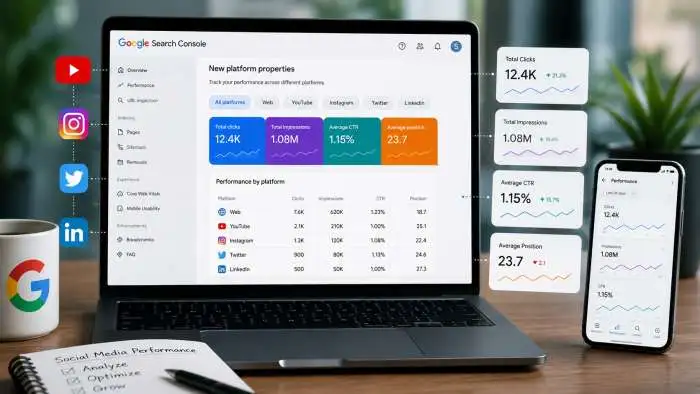
Track Your Instagram, TikTok and YouTube Traffic in Google Search Console
Imagine seeing exactly what people search for on Google before they find your TikTok video or Instagram Reel. That is now possible. Google's new platform properties for Search Console give you this superpower. This feature connects your social media accounts to Search Console. You can...

How Do You Optimize for AI Search? Essential Strategies Explained
If you want to know how to optimize for AI search, here is the simple answer: focus on creating clear, helpful, and well-structured content that answers real questions. AI systems like ChatGPT, Google's AI Overviews, and Perplexity look for content that is easy to understand, trustworthy,...

Local GEO Baseline Audit Guide: Benchmarking AI Visibility
Are you invisible to AI? A local GEO baseline audit shows exactly how AI tools like ChatGPT, Gemini, and Perplexity see your business. This audit is the starting point for all your AI search efforts. You will benchmark your current visibility, find data errors, and learn how...