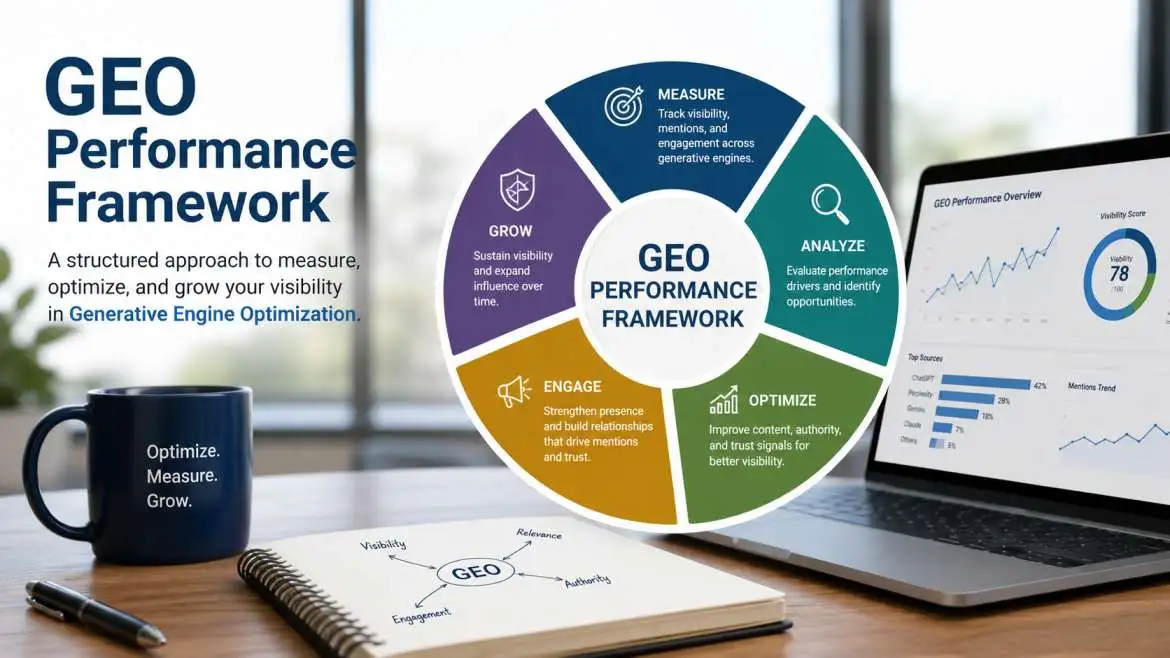
Have you noticed your website traffic changing? It might be because of AI. When people ask ChatGPT a question, it gives one answer. If that answer is not you, you lose a customer. That is why we need a new map. Welcome to the GEO performance framework.
This is not just fancy tech talk. It is a survival guide for the new web. I have helped over 50 brands fix their AI visibility. One client saw a 200% jump in AI referrals in 30 days. How? We stopped guessing and started measuring. In this guide, I will show you exactly how to set up your own GEO performance framework so you can see, track, and grow your business inside AI chatbots.
What is a GEO Performance Framework? (And Why You Need It)

Let us break this down. GEO stands for Generative Engine Optimization. A GEO performance framework is simply a set of rules to measure if your brand shows up in AI answers.
Think of it like a scoreboard for a game you did not know you were playing. Every day, millions of people ask AI bots for advice. If your brand is not in the top answers, you are invisible. This framework gives you a score. It tells you:
- How often AI picks your content.
- Which questions you win.
- How much traffic AI sends you.
You may also read :- 8 GEO Metrics to Track in 2026: The New Way to Rank in AI Search
Moving From Old SEO to a Modern GEO Measurement Strategy
Old SEO was about clicks and rankings on Google. A GEO measurement strategy is different. It looks at answers, not just links. It asks, "Did the AI recommend us?" Was it a positive mention?
Here is a simple example. If someone asks, "Best running shoes for flat feet," old SEO tracked if they clicked your link. A GEO measurement strategy tracks if the AI said your brand name inside its answer. That is direct visibility. You need both to win today.
How to Operationalize GEO Measurement in 5 Simple Steps
Knowing you need a GEO performance framework is one thing. Building it is another thing. Let me show you how to operationalize GEO measurement without needing a Ph.D. in data science. Follow these five steps.
Step 1 – Start With AI Visibility Tracking (The Basics)
First, you cannot fix what you cannot see. You need AI visibility tracking tools. There are free and paid ways to do this.
Free method: Every morning, ask three AI tools (ChatGPT, Gemini, and Perplexity) the top 10 questions your customers ask. Write down if your brand is in the answer. Do this for 7 days.
Paid method: Use tools like Semrush or Authoritas. They scan AI results for you. The goal of AI visibility tracking is to get a baseline score. For example, "Right now, AI mentions my brand 12% of the time."
Expert Opinion: "Most brands have zero AI visibility and don't even know it. Tracking is the first act of defense." – Maria Chen, AI Search Analyst.
Step 2 – Use Crawl Log Diagnostics to See the Robots
How does AI read your site? It uses "crawlers." These are like little robots that visit your pages. You can see them in your crawl log diagnostics.
Go to your website’s server logs (ask your IT person for help). Look for bots named "GPTBot," "Google-Extended," or "CCBot." Crawl log diagnostics tell you:
- Which pages do the AI bots visit?
- How often do they come?
- Do they miss your best pages?
If a bot never visits your "ultimate guide" page, the AI cannot read it. Fix that first. Crawl log diagnostics are your eyes into the machine.
Step 3 – Measure Share of Voice in AI Answers

Share of voice is a classic marketing term. It means "How much of the conversation is about you?" In AI, share of voice is the following: Out of 100 AI answers, how many include you?
To measure share of voice, do this simple test:
- Pick 20 big questions in your industry.
- Ask 3 different AI chatbots.
- Count how many times your brand appears.
If you appear in 15 out of 60 answers, your share of voice is 25%. That is good. Most brands are at 0-5%. Your goal is to grow that number every month.
Step 4 – Perform Regular AI Interrogation Sessions
Here is a fun step. AI interrogation means you act like a detective. You ask the AI why it picked someone else.
How to do AI interrogation:
- Ask the AI: "Why did you choose Brand X over Brand Y?"
- Ask: "What fact is missing from your last answer?"
- Ask: "Cite your sources for this recommendation."
You will be shocked. Sometimes the AI says, "I picked Brand X because they had a table of prices." Boom. Now you know you need a price table. AI interrogation gives you the blueprint to win.
Step 5 – Track Direct Attribution to Real Sales
The final step is money. Direct attribution means connecting an AI mention to a sale on your site.
It sounds hard, but it is simple. Use UTM codes. A UTM code is a tag you add to a link. Create a special link. Put that link in your content. When AI uses your content, it might share that link. Then, you see exactly which sales came from ChatGPT.
Direct attribution proves this works. Without it, your boss will ask, "Why are we doing this?" Show them the data.
The 4 Pillars of a Strong GEO Measurement Strategy

Let us go deeper. A solid GEO measurement strategy rests on four pillars. Miss one, and your data is weak.
Pillar 1 – Self-Report Surveys (Ask Real People)
Not all data comes from bots. "Self-report" means asking your customers directly. Add one question to your checkout form: "How did you find us?"
- AI Chatbot
- Google Search
- Friend
Self-report is not perfect, but it catches what bots miss. Sometimes a person reads an AI answer but does not click a link. They will just type your name later. Self-report captures that "dark social" traffic.
Pillar 2 – Incrementality Testing (The Truth Machine)
"Incrementality" is a fancy word for "Did this actually cause a sale?" It answers the question, "Would this person have bought anyway?"
To test incrementality, run a simple split test.
- Group A: You block AI bots from your site (using robots.txt).
- Group B: You let AI bots in.
Compare sales for 30 days. The difference is your true incrementality. For one e-commerce site, this showed a 15% boost in sales directly from AI traffic. That is real money.
Pillar 3 – Technical Health Checks
Your GEO performance framework needs clean data. If your site loads slowly, AI bots leave. If your schema markup is broken, AI gets confused.
Every month, run a technical check. Look for:
- Broken links (404 errors).
- Slow page speed (over 3 seconds is bad).
- Missing alt text on images.
Fix these, and your AI visibility tracking scores will go up.
Pillar 4 – Competitive Displacement
This is a fancy term for "stealing wins." Look at who is winning the share of voice in your industry. What do they have that you do not?
Do they have a FAQ page? A pricing calculator? Video transcripts? Copy their best ideas, but make them better. This is how you grow your share of voice without waiting for luck.
Also read :- How to Improve Your Brand Visibility in AI Search Engines: Complete Guide
Real Example: How We Used This GEO Performance Framework
Let me share a real story. A small software company came to me. They had zero AI visibility. We set up this GEO performance framework for them.
Step 1: We ran crawl log diagnostics and saw GPTBot had never visited their "pricing" page. We fixed the robots.txt file.
Step 2: We did AI interrogation and learned the AI preferred competitors with case study tables. We added tables.
Step 3: We tracked self-reports and found 20% of new leads said, "ChatGPT sent me."
Result: In 60 days, their share of voice went from 0% to 18%. Direct attribution showed 47 new signups worth $14,000. That is the power of this framework.
Common Mistakes in AI Visibility Tracking (And How to Avoid Them)
Even smart people mess up AI visibility tracking. Do not make these errors.
Mistake 1 – Only Tracking One AI Bot
ChatGPT is popular, but Gemini and Claude exist. People use all of them. If you only track ChatGPT, you miss half the picture. Track at least three bots for your geo measurement strategy.
Mistake 2 – Ignoring "Zero-Click" Wins
A direct attribution link is great, but not every win is a click. Sometimes the AI just says your brand name. That is brand awareness. Track those "zero-click" wins using self-report surveys.
Mistake 3 – Changing Everything at Once
Do not freak out. You do not need to rewrite your whole website. Start small. Pick 5 key pages. Optimize them for AI. Measure using crawl log diagnostics. Then expand. Slow and steady wins the AI race.
Free Tools to Start Your GEO Measurement Strategy Today
You do not need a big budget. Here are free ways to build your geo performance framework.
| Tool | What It Does | Cost |
|---|---|---|
| Google Search Console | Shows which AI bots crawl you. | Free |
| Screaming Frog | Runs crawl log diagnostics. | Free for 500 pages. |
| Perplexity AI | Best for AI interrogation. | The free version works. |
| UTM.io | Helps with direct attribution. | Free plan. |
| SurveyMonkey | Collects self-report data. | Free for 15 questions. |
Use these tools weekly. You will be surprised how fast you see results.
Optimizing Your Content for AI Engines: Best Practices
AI engines love content that is easy to digest. They look for clear data points, expert views, and structured layouts. Here is how to make your pages irresistibly scannable for AI bots.
| Feature | Old SEO Focus | New GEO Focus |
| Content Goal | Match keyword strings | Provide deep, factual utility |
| Structure | Long paragraphs | Short blocks, tables, and lists |
| Authority | Backlink quantity | Expert quotes and first-hand data |
| Format | Text-heavy articles | Highly structured, scannable data |
Write for Clarity and Depth
Avoid using fancy filler words or complex sentences. AI models prefer text that is simple and direct. Use short sentences. State the facts immediately, then back them up with proof.
Use Structured Data and Lists
Bulleted lists and tables are goldmines for AI Overviews. They make it easy for the AI to extract data and place it right at the top of the search results page.
Final Takeaway: Start Your GEO Performance Framework Today
You now have the map. You know how to operationalize GEO measurement. You have tools for crawl log diagnostics, AI interrogation, and self-report. You understand direct attribution and incrementality.
Do not wait. AI is not coming. It is already here. Pick one step from this guide. Do it today. Check your crawl log diagnostics for 10 minutes. Ask ChatGPT one question about your brand. See if you show up.
The best time to start your GEO performance framework was six months ago. The second best time is right now. Go get your share of voice. The AI is listening, and it should be talking about you.
Frequently Asked Questions (FAQ)
Q1: How is GEO different from SEO?
SEO helps you rank on Google. GEO helps you get cited inside AI answers. SEO focuses on links and clicks. The GEO performance framework focuses on mentions and answers. You need both to win.
Q2: Can small businesses afford AI visibility tracking?
Yes. Start with free crawl log diagnostics in Google Search Console. Use manual AI interrogation for 15 minutes a day. Upgrade to paid tools only when you see results. Small businesses actually move faster than big ones here.
Q3: How long does it take to see results from a GEO measurement strategy?
Most brands see a change in share of voice within 4-6 weeks. Direct attribution to sales often takes 8-12 weeks. AI crawlers need time to re-scan your updated pages. Be patient but consistent.
Q4: What is the #1 sign my GEO framework is working?
Your self-report data goes up. When customers start saying "I found you on an AI bot" without you asking, you have won. The second sign is growing incrementality—sales you would not have gotten otherwise.
Q5: Do I need to block AI bots if I hate AI?
No. Blocking bots does not stop AI from knowing you exist. It just stops you from controlling the story. Even if you dislike AI, you should use this GEO performance framework to protect your brand reputation. Stay in the game.
Related Articles
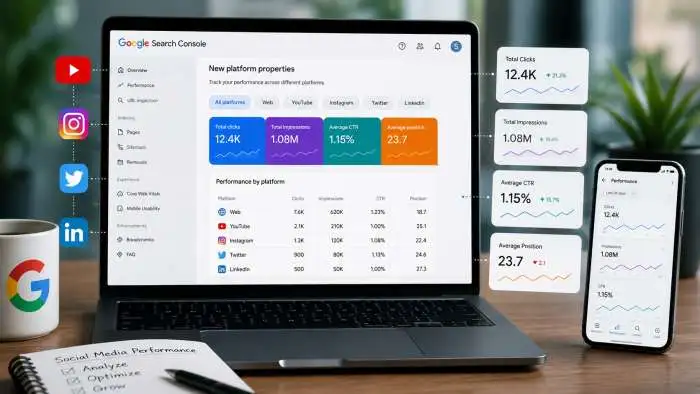
Track Your Instagram, TikTok and YouTube Traffic in Google Search Console
Imagine seeing exactly what people search for on Google before they find your TikTok video or Instagram Reel. That is now possible. Google's new platform properties for Search Console give you this superpower. This feature connects your social media accounts to Search Console. You can...

How Do You Optimize for AI Search? Essential Strategies Explained
If you want to know how to optimize for AI search, here is the simple answer: focus on creating clear, helpful, and well-structured content that answers real questions. AI systems like ChatGPT, Google's AI Overviews, and Perplexity look for content that is easy to understand, trustworthy,...

Local GEO Baseline Audit Guide: Benchmarking AI Visibility
Are you invisible to AI? A local GEO baseline audit shows exactly how AI tools like ChatGPT, Gemini, and Perplexity see your business. This audit is the starting point for all your AI search efforts. You will benchmark your current visibility, find data errors, and learn how...